Direct Policy Search
(BBO & PG)
GitHub Repository
Aims
- Directly learn a policy (no intermediate $Q^\pi_\theta(s, a)$)
- Policy from a control perspective
- Policy gradient from a classification perspective
Outline
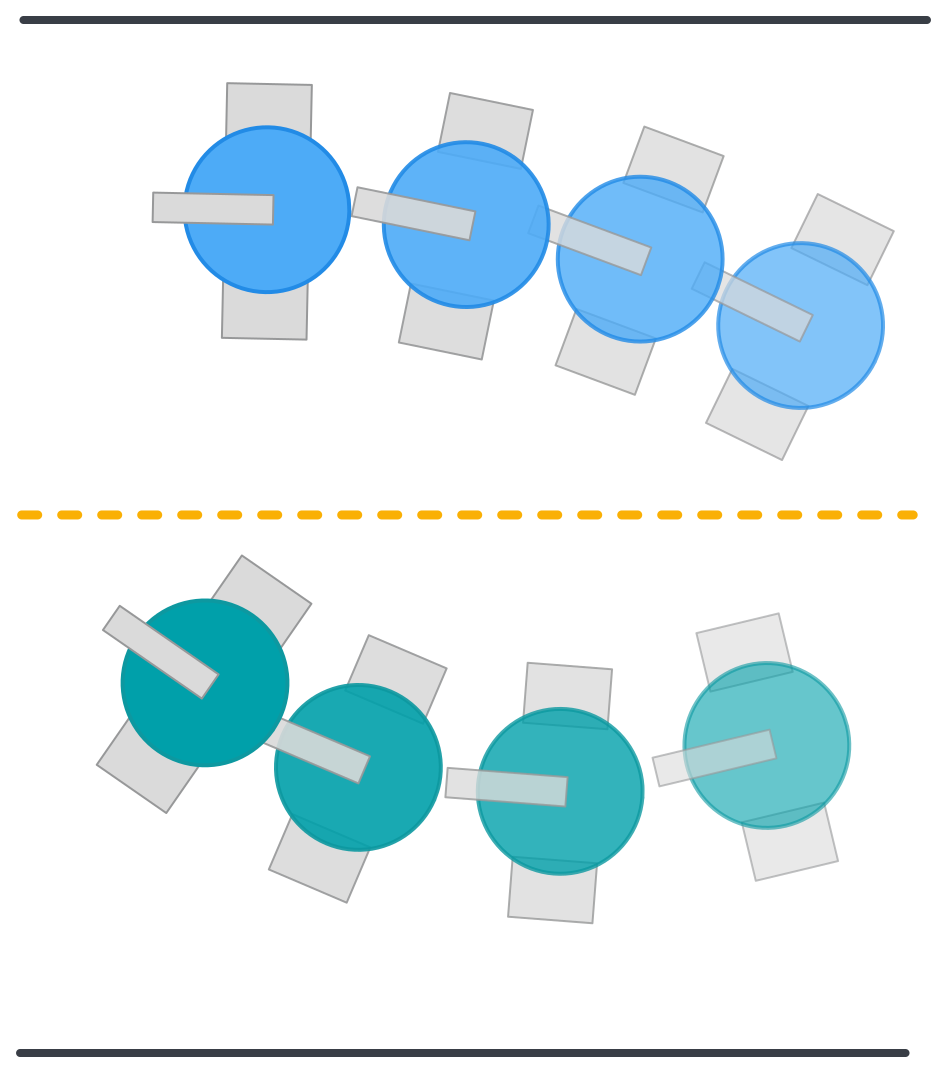
- From line following to autonomous racing
- Bang-bang and PD controller
- Black-box optimization
- From classification to policy gradient
Line following (2014)
Line following and autonomous racing
Learning to race in minutes
Learning to race in an hour
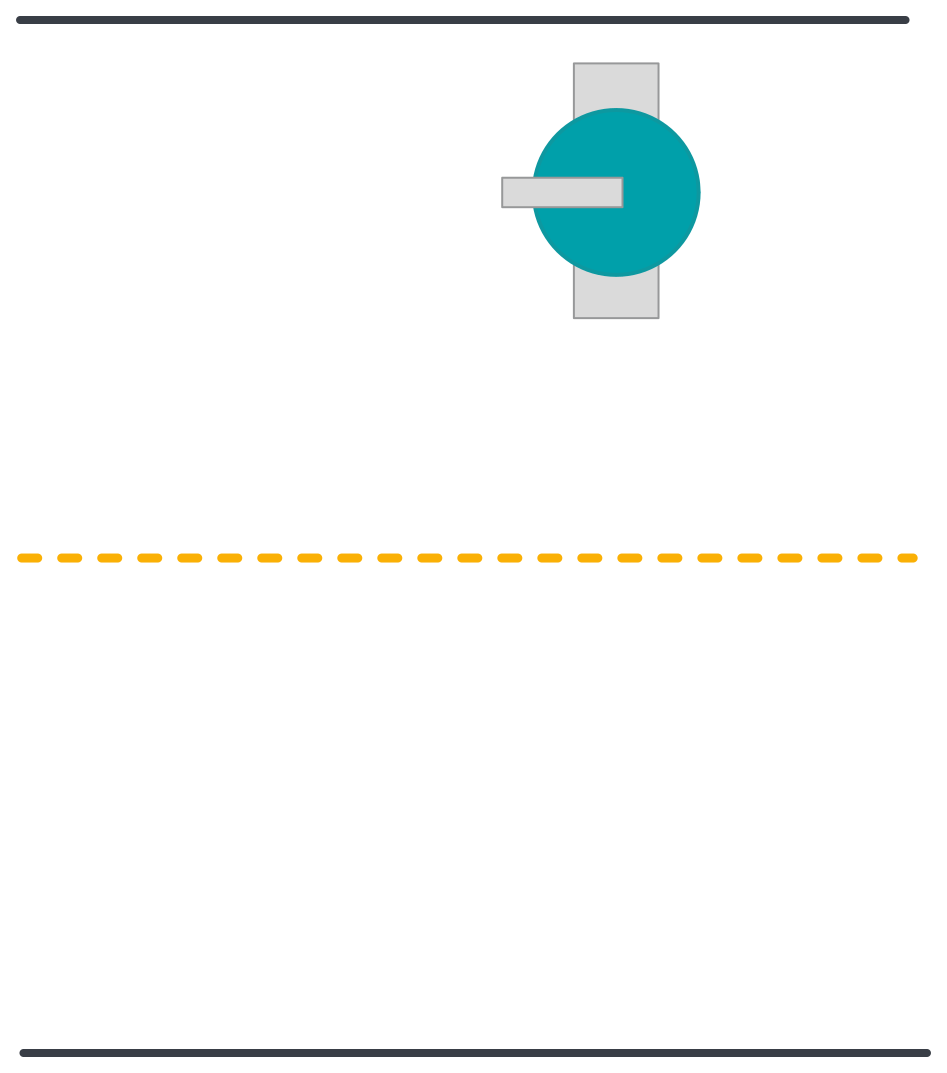
Differential-Drive Robot
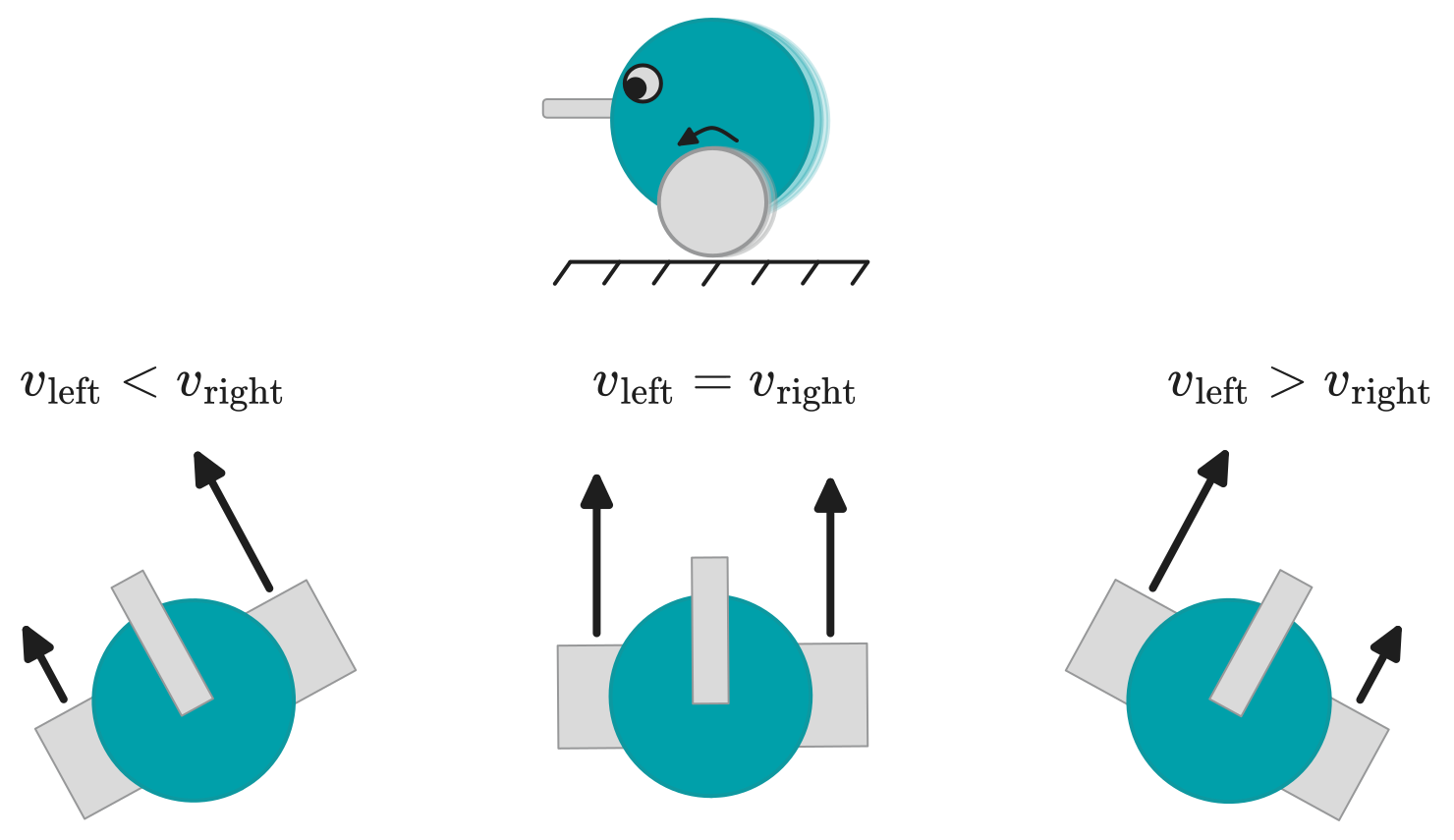
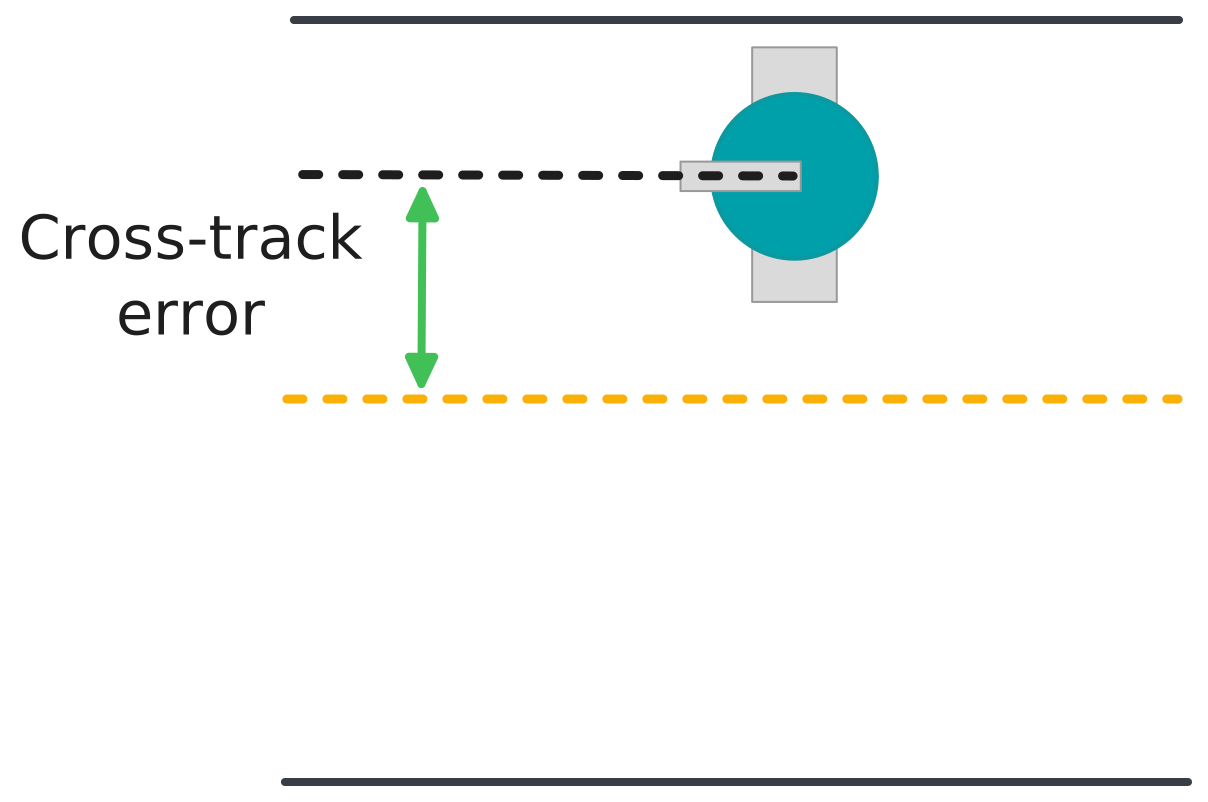
Observation Space
                                obs_high = np.array(
                                    [
                                        self.off_track_threshold,  # lateral error
                                        np.inf,  # lateral error derivative
                                    ],
                                    dtype=np.float32,
                                )
                                self.observation_space = spaces.Box(low=-obs_high, high=obs_high)
                                # Later:       [lateral_error, heading_error, forward_velocity,
                                #               angular_velocity, left_wheel_speed, right_wheel_speed,
                                #               curvature, lookahead_lat_2, lookahead_lat_4, lookahead_lat_6]
Action Space
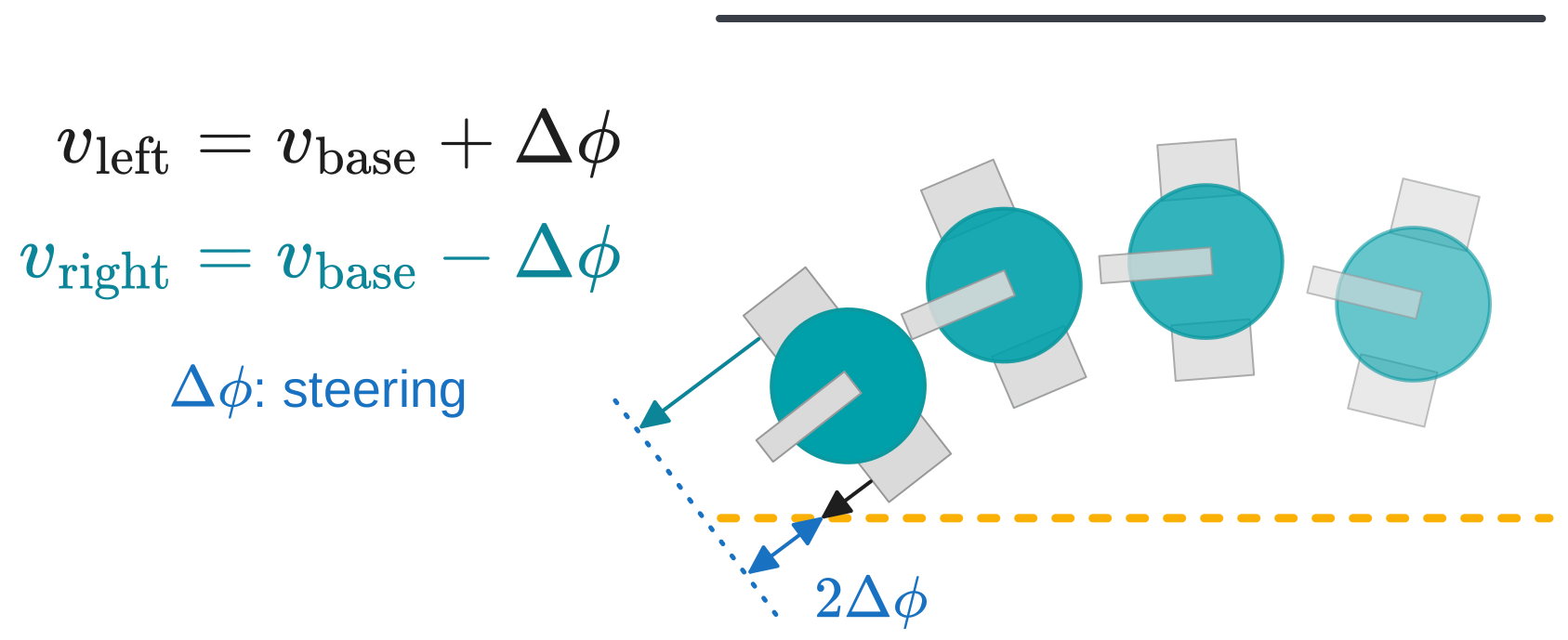
                                # Action: [left_wheel_speed, right_wheel_speed]
                                left_wheel_speed = base_speed + steering
                                right_wheel_speed = base_speed - steering
                                # 1-D action  →  steering ∈ [-1, 1]
                                self.action_space = spaces.Box(low=-1.0, high=1.0, shape=(1,))
Reward
Stay close to the line while moving forward
                            # Note: always normalize!
                            lateral_penalty = -((lateral_error / self.off_track_threshold) ** 2)
                            alive_bonus = 1.0  # otherwise might try to terminate early
                            reward = alive_bonus + lateral_penalty + forward_velocity
What can be changed for racing?
Termination conditions?
Move forward and stay on the track
                            off_track = abs(lateral_error) > self.off_track_threshold
                            terminated = off_track or going_reverse
                            truncated = self.step_count >= self.max_episode_steps  # timeout
Note: timeout/truncation needs special handling in the algorithm
- From line following to autonomous racing
- Bang-bang and PD controller
- Black-box optimization
- From classification to policy gradient
Bang-Bang Control
                            if lateral_error > 0:
                                action = STEER_LEFT
                            else:
                                action = STEER_RIGHT
PD Control
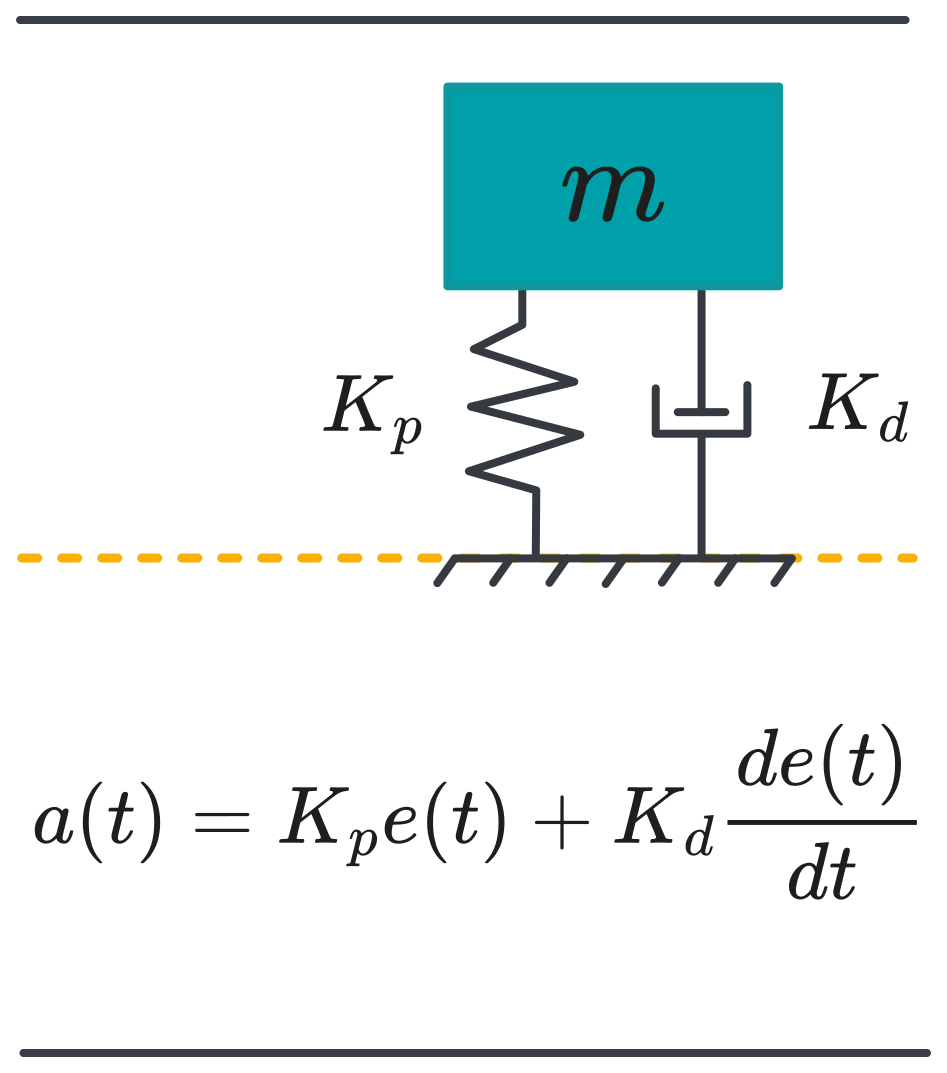
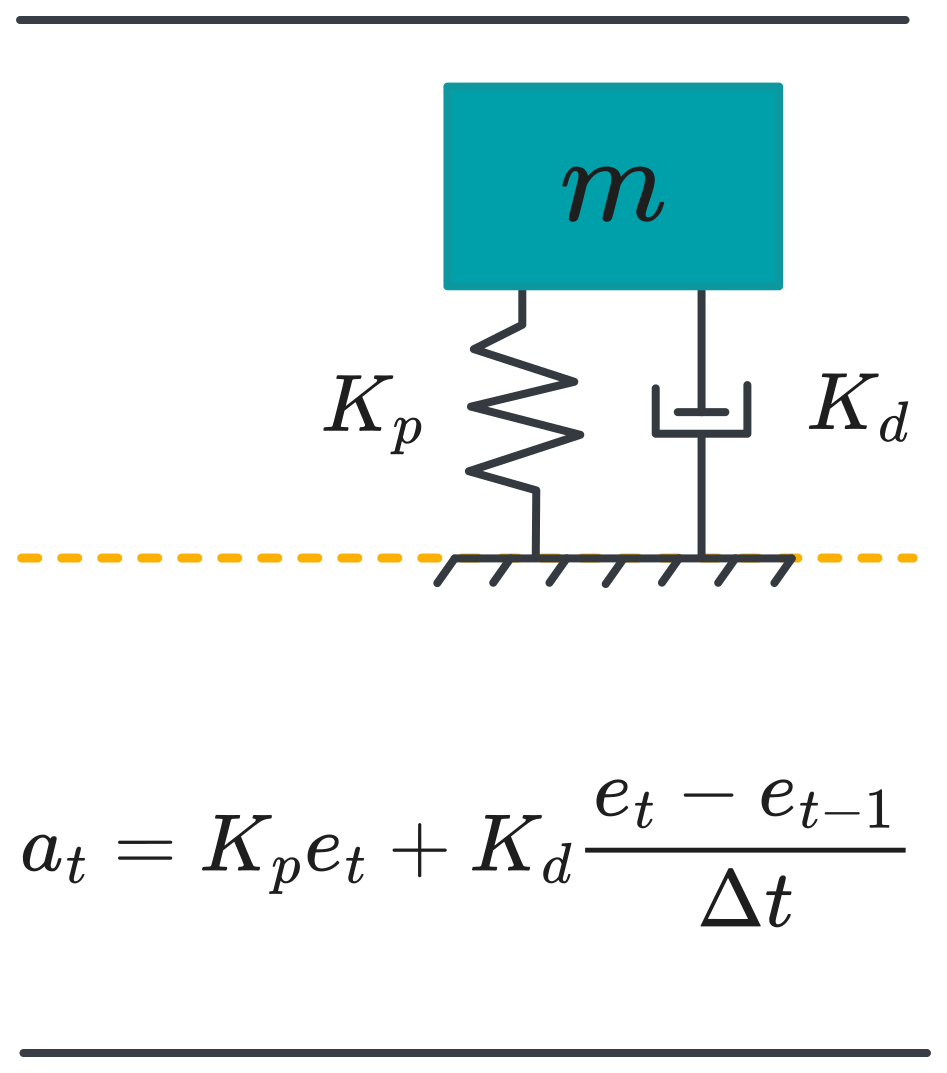
PD Controller as Policy
$a_t = \textcolor{#1864ab}{K_p} \textcolor{#a61e4d}{e_t} + \textcolor{#1864ab}{K_d} \textcolor{#a61e4d}{\frac{e_t - e_{t -1}}{\Delta t}}$
$a_t = \begin{bmatrix} \textcolor{#1864ab}{K_p} & \textcolor{#1864ab}{K_d} \end{bmatrix} \cdot \begin{bmatrix} \textcolor{#a61e4d}{e_t} \\ \textcolor{#a61e4d}{\frac{e_t - e_{t -1}}{\Delta t}} \end{bmatrix}$
$a_t = \textcolor{#1864ab}{\theta}^\top \textcolor{#a61e4d}{s_t}$
$\pi_{\textcolor{#1864ab}{\theta}}(\textcolor{#a61e4d}{s_t}) = \textcolor{#1864ab}{\theta}^\top \textcolor{#a61e4d}{s_t}$ a linear policy!
Questions?
- From line following to autonomous racing
- Bang-bang and PD controller
- Black-box optimization
- From classification to policy gradient
How to find a good policy?
$\pi_{\textcolor{#1864ab}{\theta}}(\textcolor{#a61e4d}{s_t}) = \begin{bmatrix} \textcolor{#1864ab}{K_p} \\ \textcolor{#1864ab}{K_d} \end{bmatrix}^\top \textcolor{#a61e4d}{s_t} = \textcolor{#1864ab}{\theta}^\top \textcolor{#a61e4d}{s_t}$
- how to find $K_p$, $K_d$ automatically?
- how to extend $s_t$?
ex: $s_t = [e_t, \frac{e_t - e_{t -1}}{\Delta t}, v_t, \text{curv}_t \ldots]$ - more complex policy $\pi_\theta$?
Black-Box Optimization
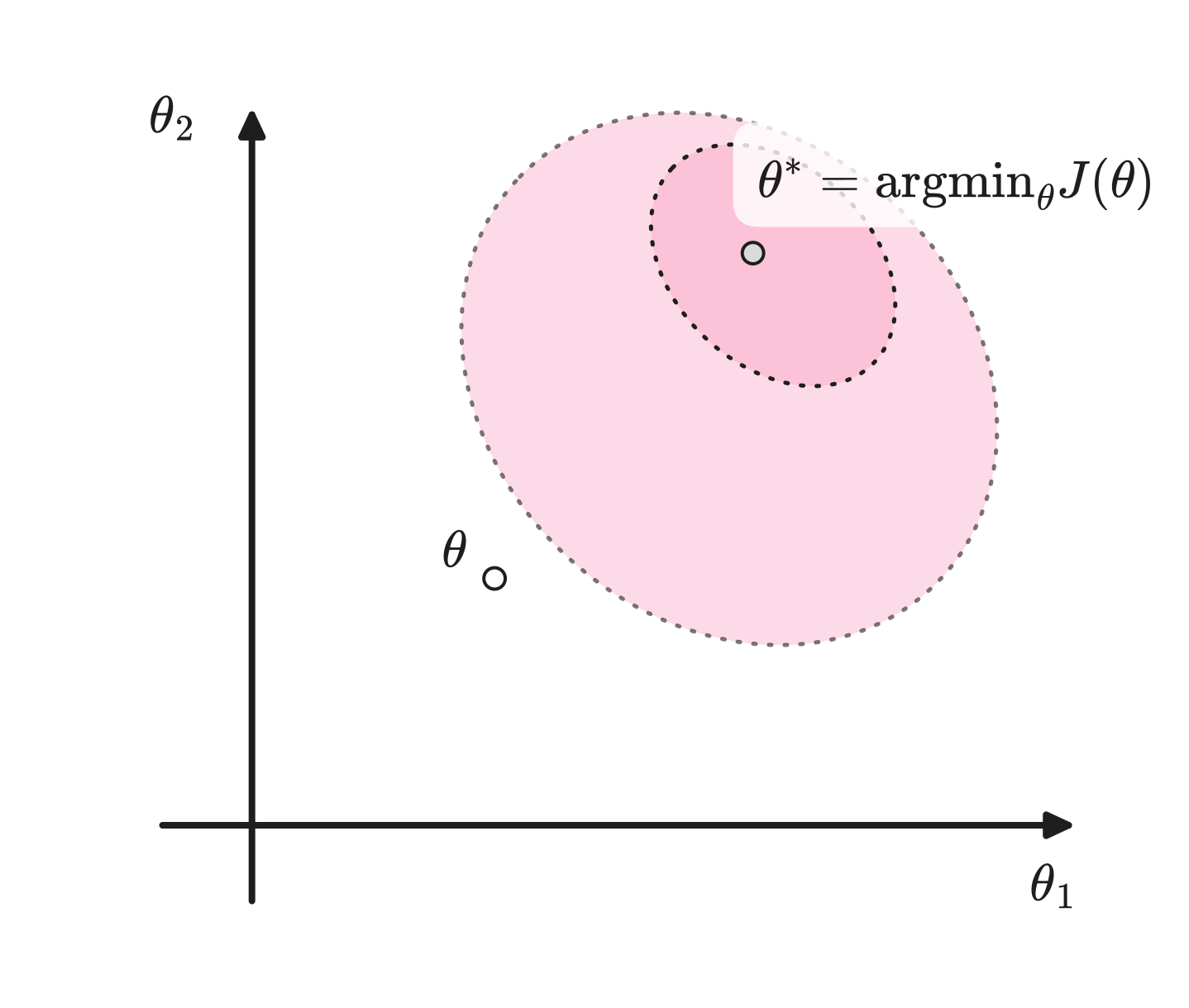
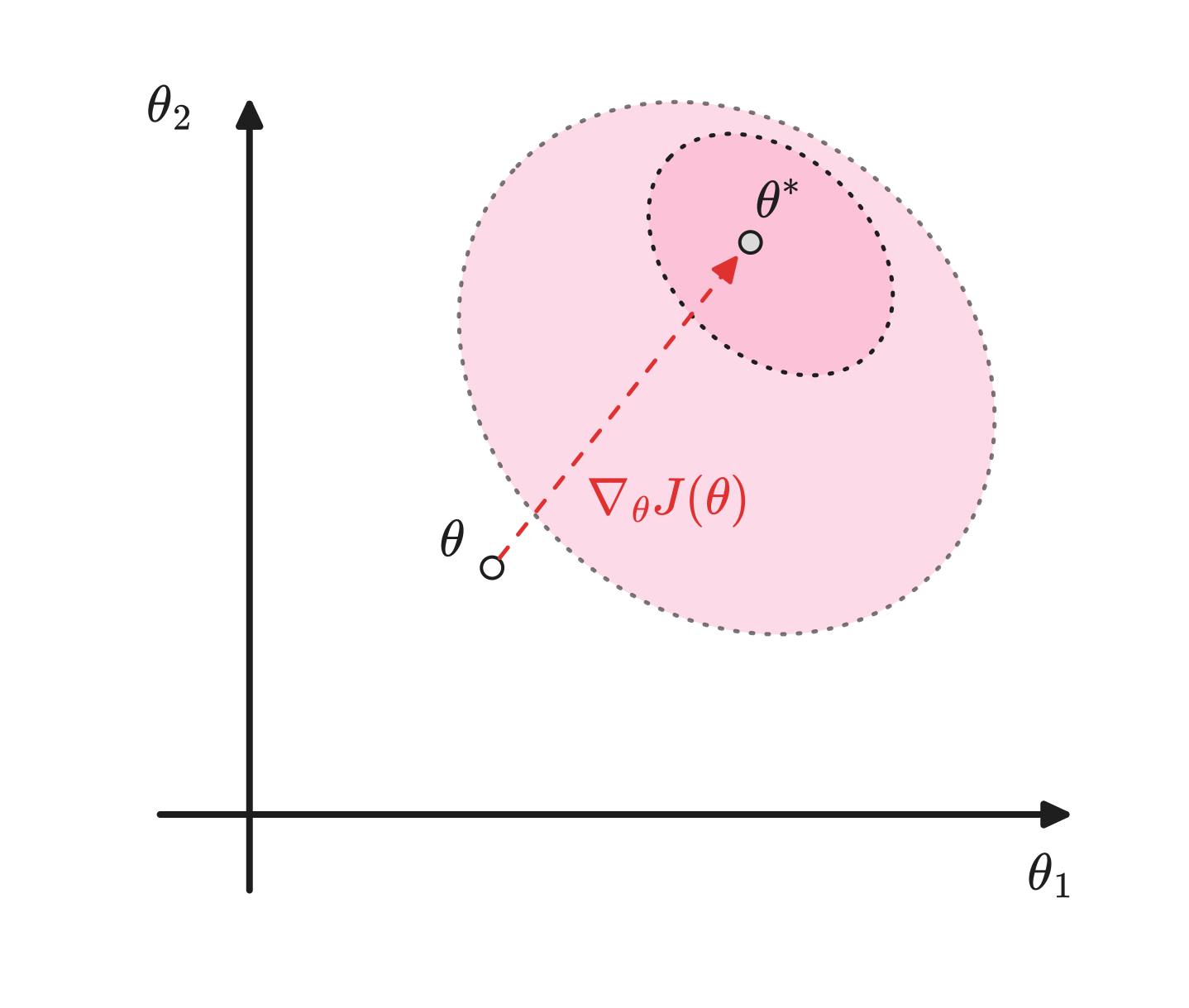
$\theta^* = \text{argmin}_{\theta}{J(\theta)}$
Episodic RL?
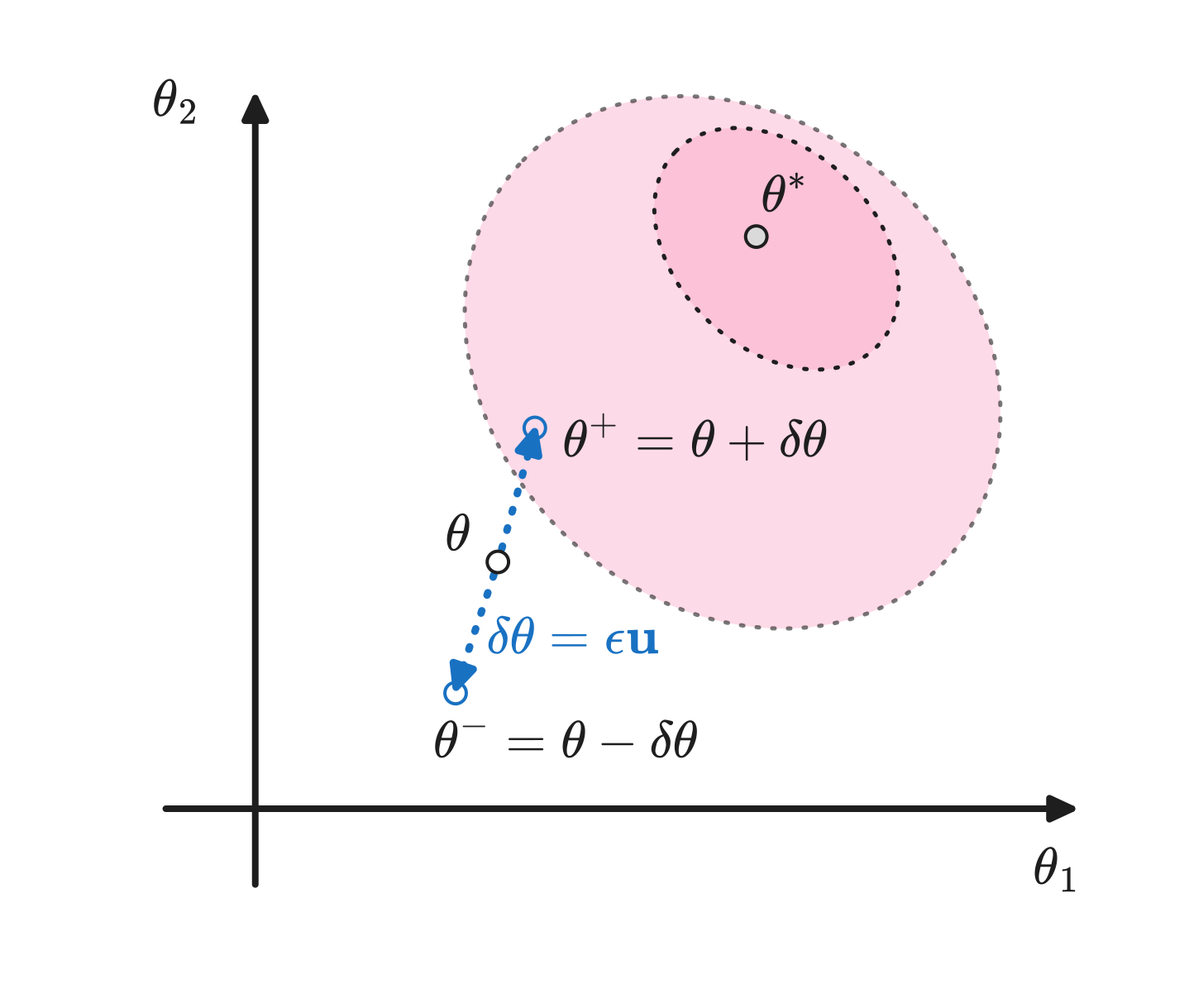
Exploration in Parameter Space
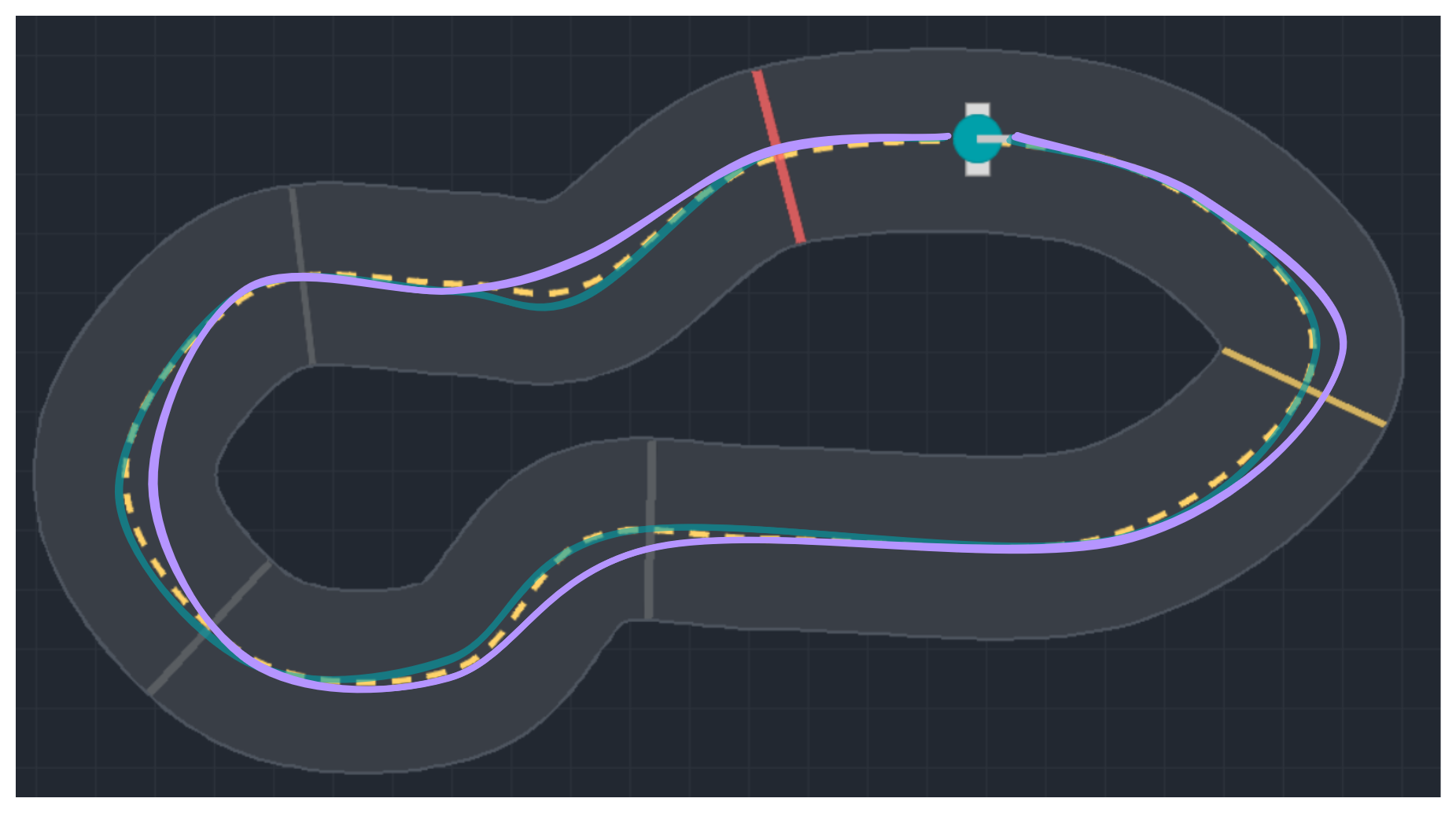
Finding better gains for the PD controller
$\tilde{\theta} = \begin{bmatrix} K_p \\ K_d \end{bmatrix} + \textcolor{#1864ab}{\begin{bmatrix} \epsilon_1 \\ \epsilon_2 \end{bmatrix}}$
\[ a_t = (\theta + \textcolor{#1864ab}{\theta_{\epsilon}})^{\top}s_t \]
Learning from human feedback
Raffin, Antonin, "Enabling Reinforcement Learning on Real Robots." Diss. TUM, 2024.
Adapting quickly: Retrained from Space
A Simple Evolution Strategy (ES)
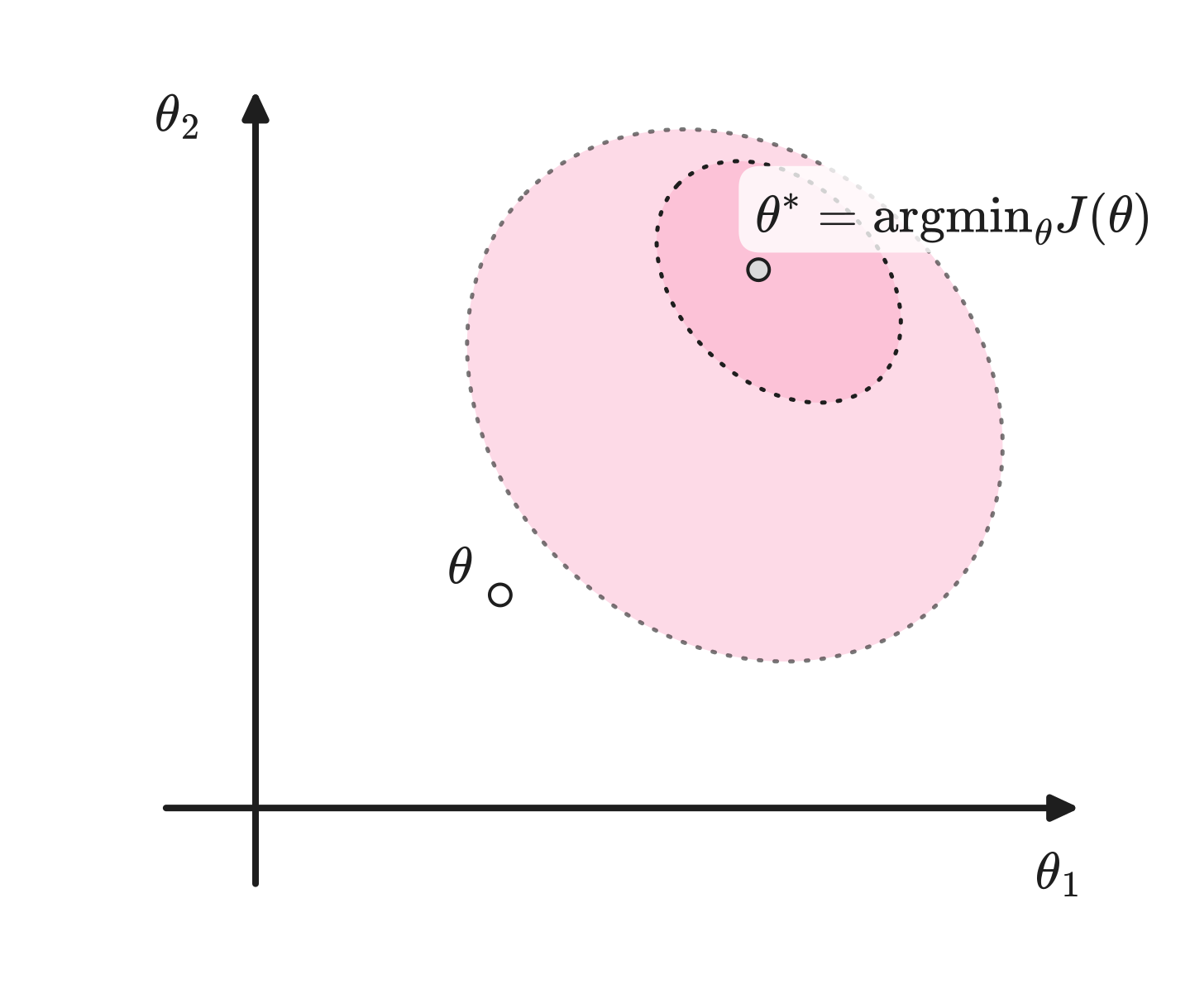
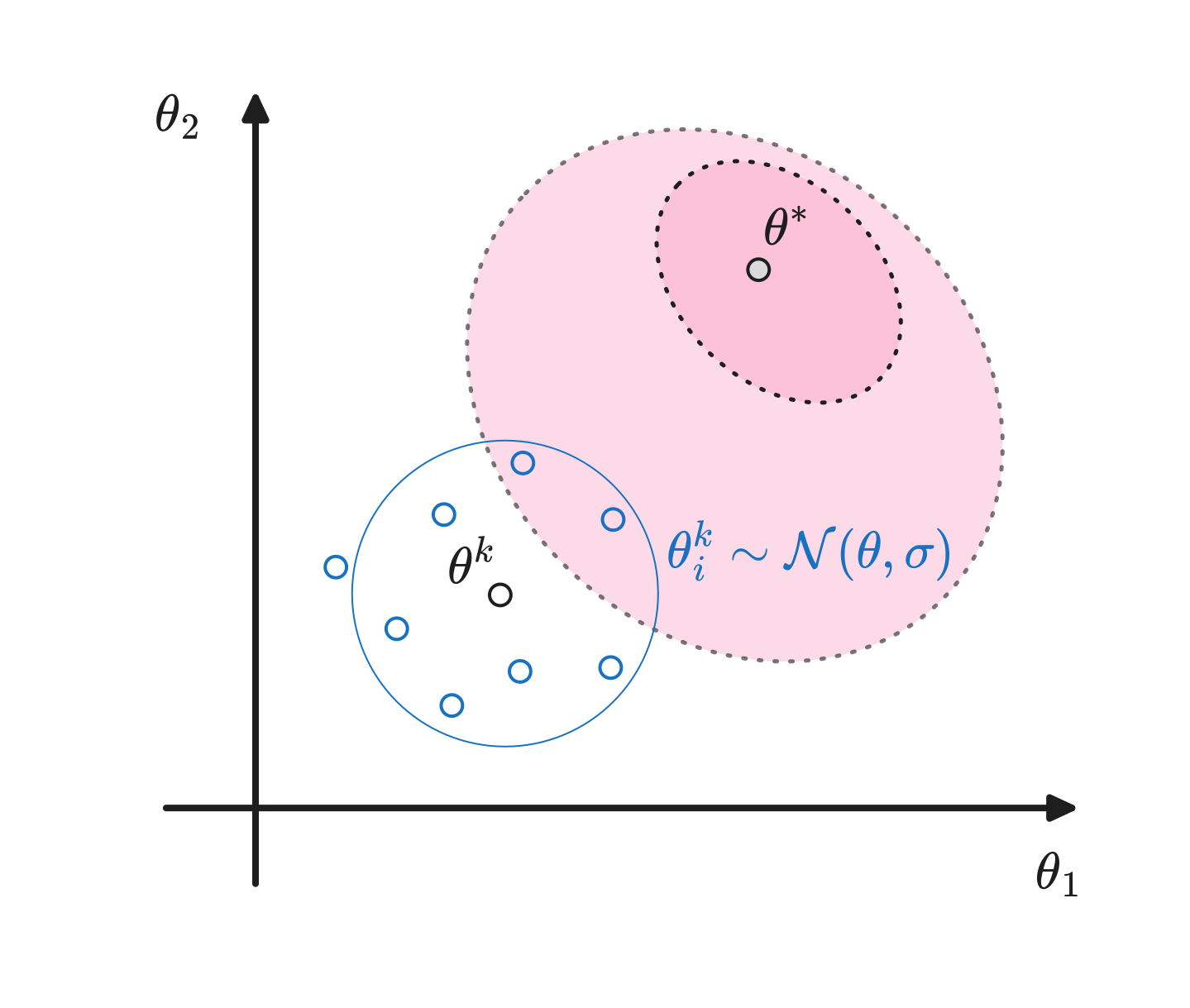
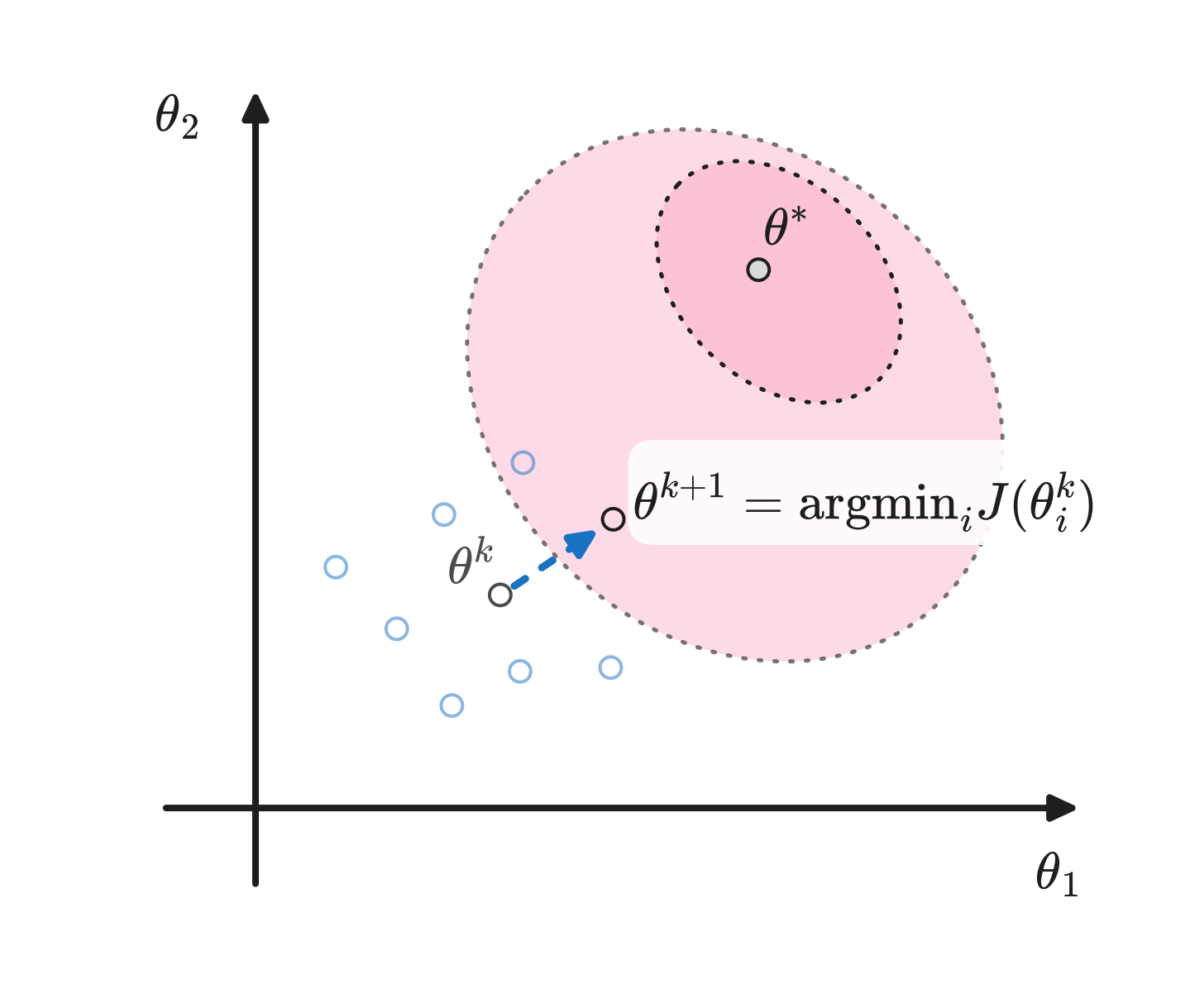
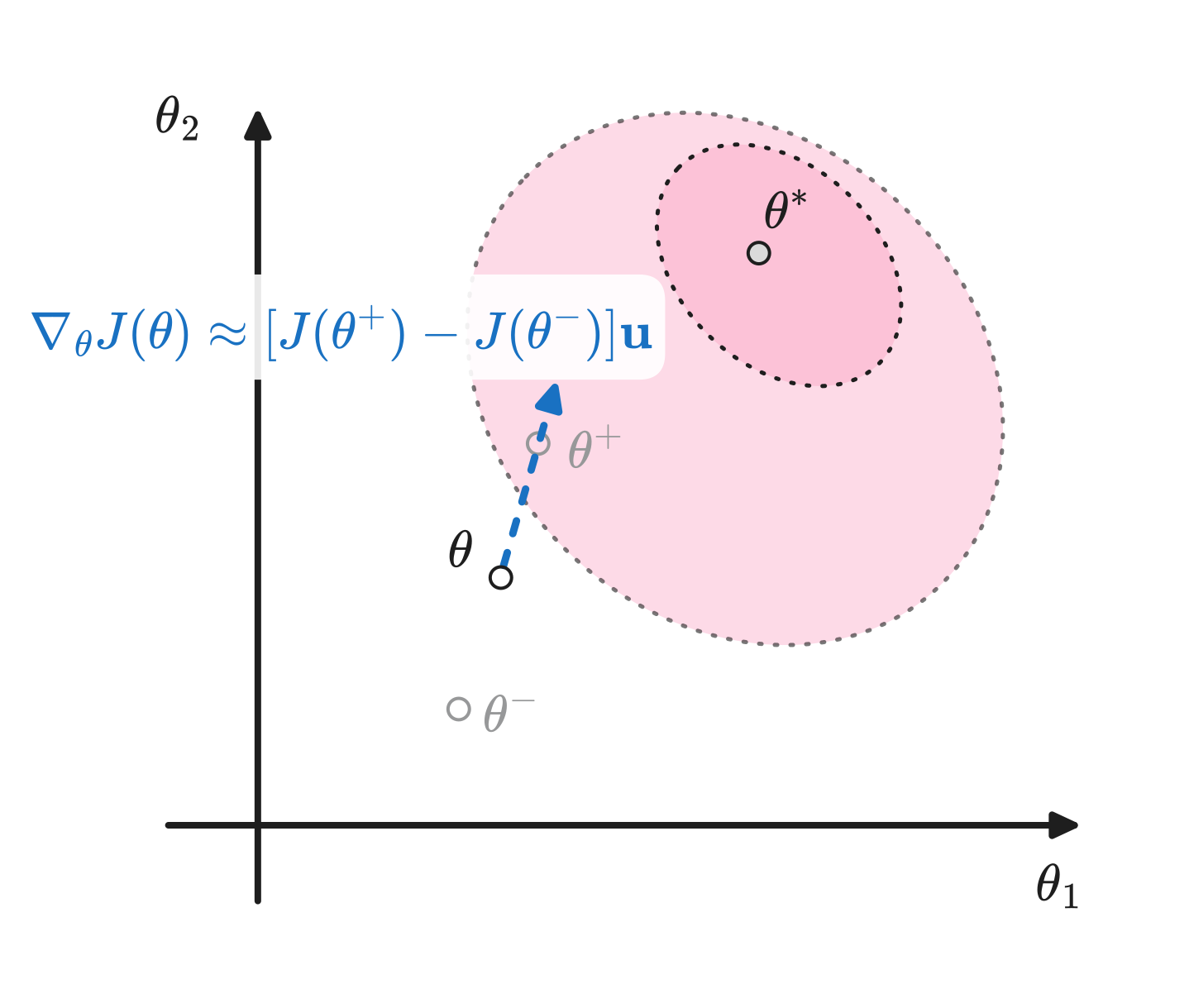
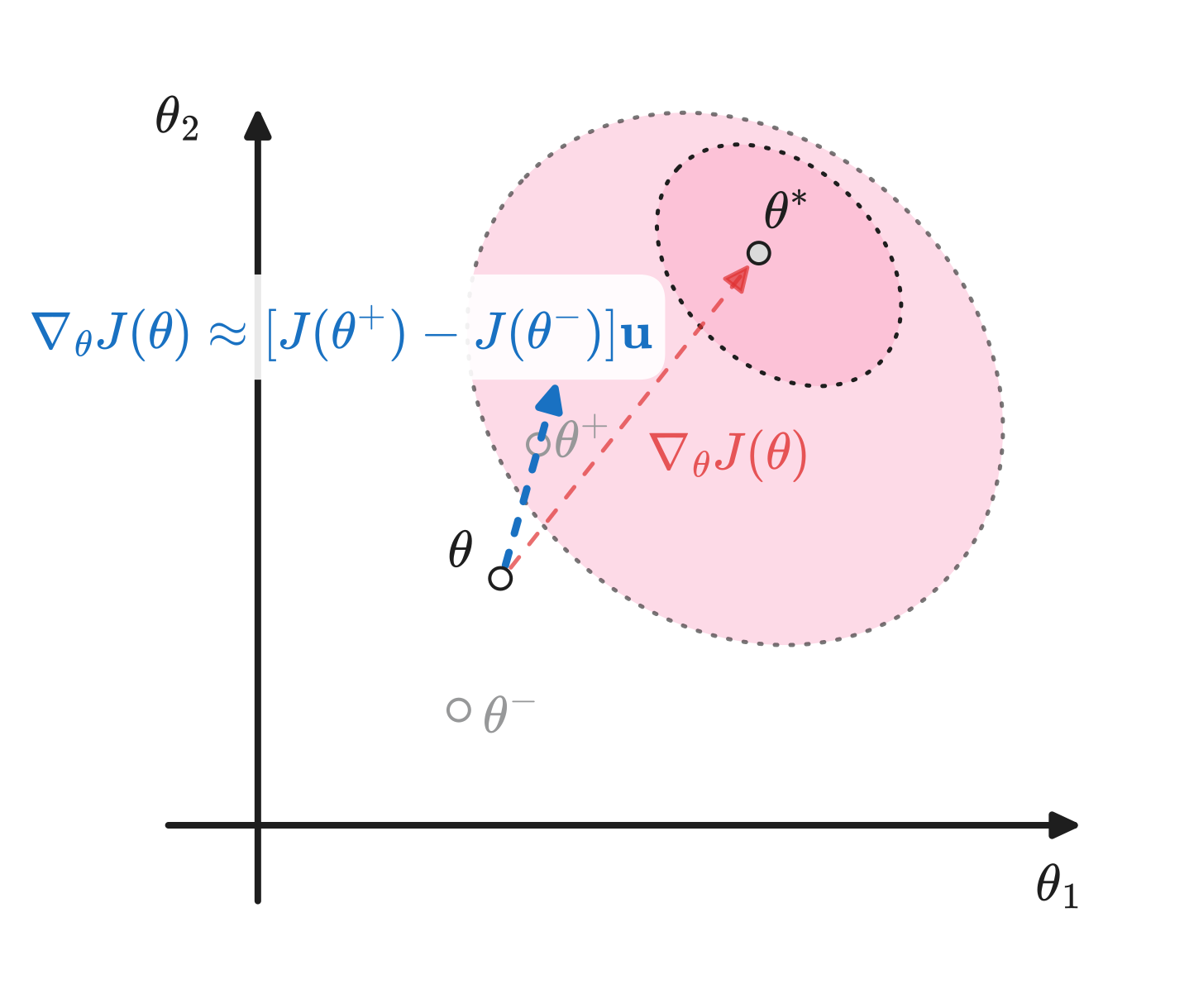
Transition: Finite Difference
Mania, Horia, et al. "Simple random search provides a competitive approach to reinforcement learning." NeurIPS 2018
Transition: Finite Difference (2)
Questions?
PD Control and Black-Box Optimization (1st notebook)
https://github.com/araffin/rlss26-pg-tutorialWARNING: LLMs are tools, solutions notebooks are provided, mistakes are the best way to learn.
- From line following to autonomous racing
- Bang-bang and PD controller
- Black-box optimization
- From classification to policy gradient
BBO Limitations
- Does not use $r_t$, only $R(\tau)$
- Does not scale when $\pi_\theta$ is more complex
- Policy gradient?
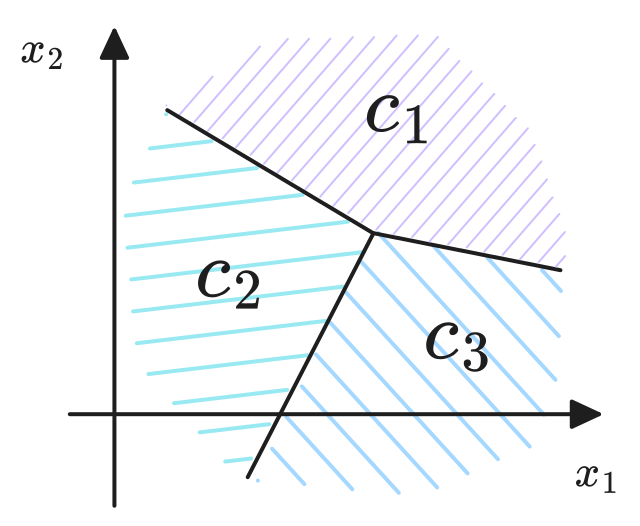
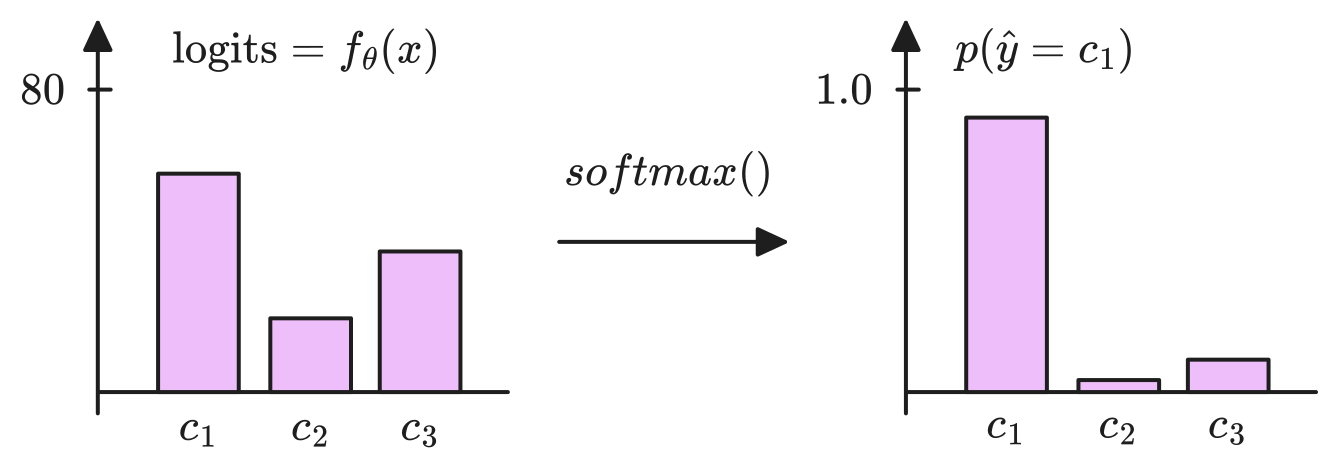
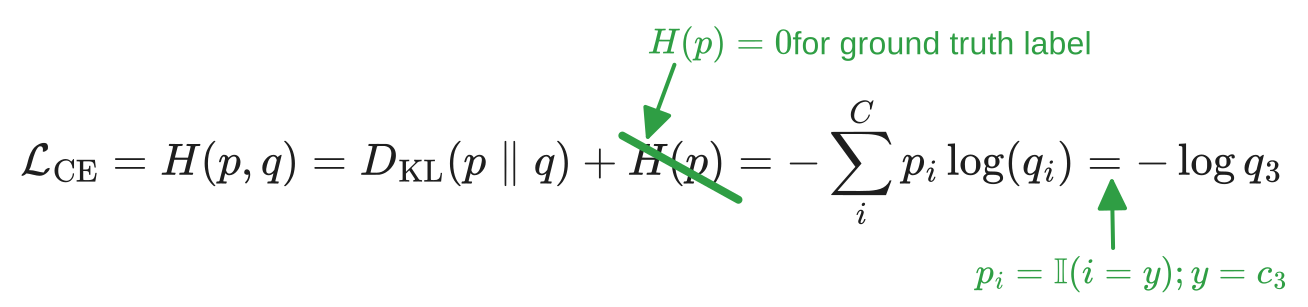
Classification 101
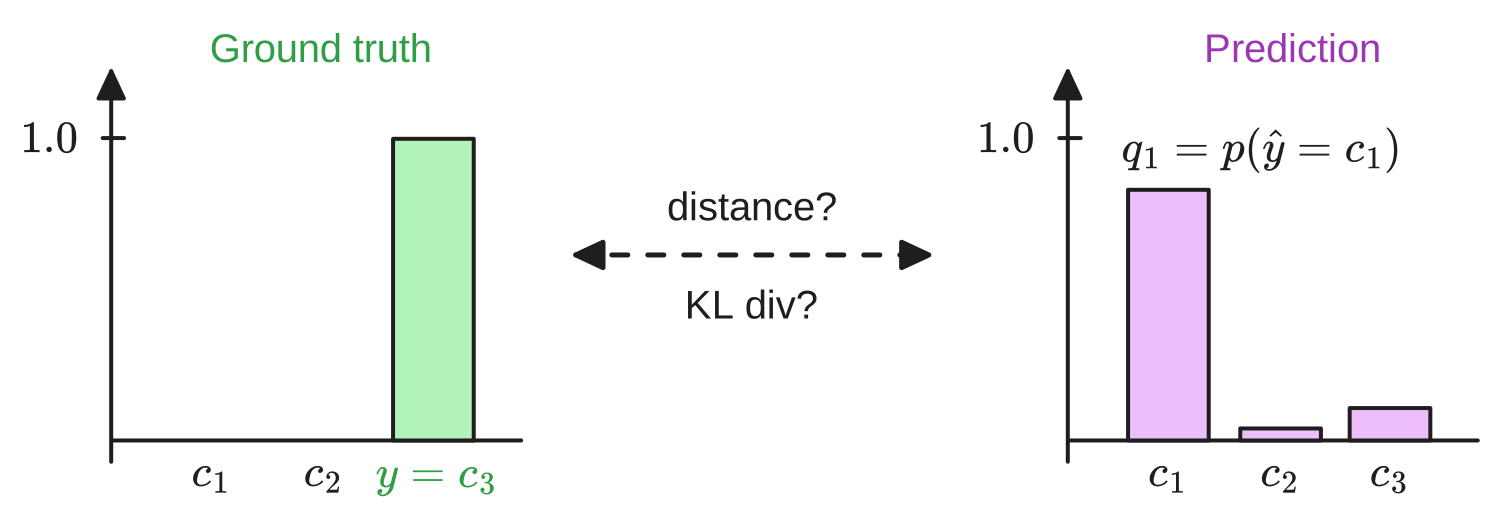
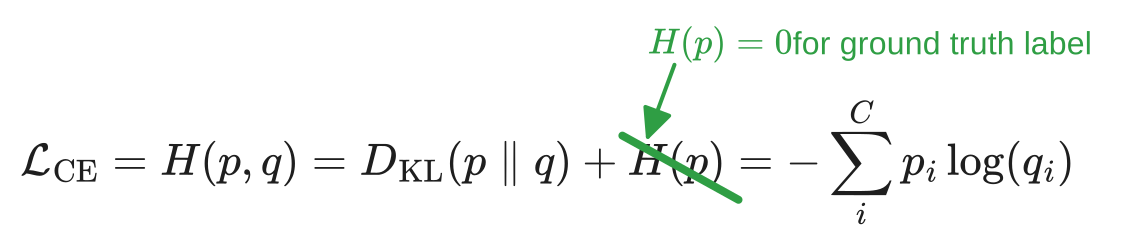
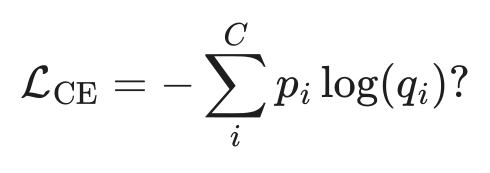
Cross-Entropy Loss

RL as classification (1)
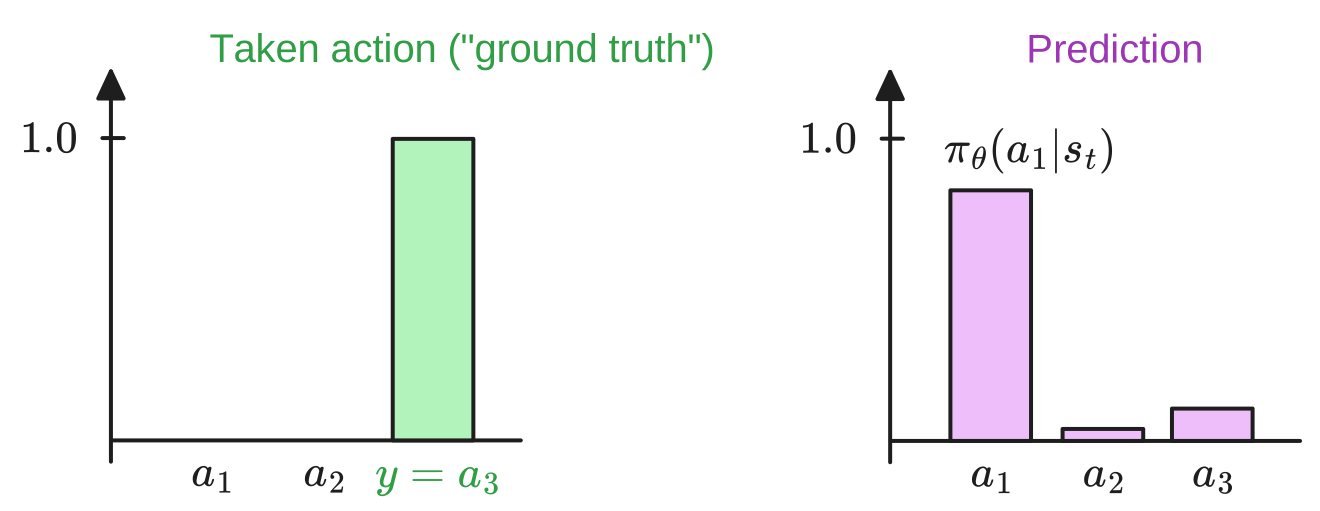
Deep Reinforcement Learning: Pong from Pixels - Andrej Karpathy (2016)
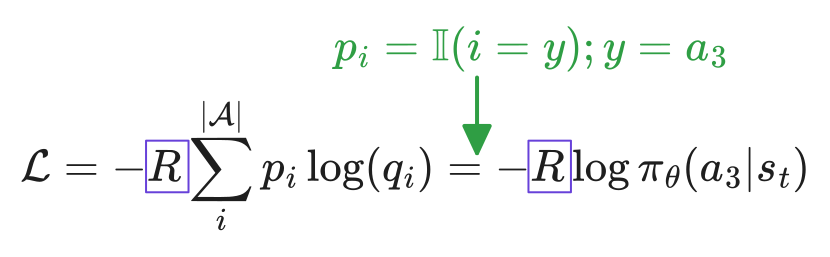
RL as classification (2)
- $R$ acts as weight
- $R > 0$ (win → reinforce the taken action)
- $R < 0$ (lose → make the taken action less likely)
RL as classification (3)
Discretized version: $\Delta \phi \in \{-1, -0.5, 0.0, 0.5, 1.0\}$
- Ex: taken action is $\Delta \phi = -1.0$ (left)
- Error reduced → reinforce the taken action
- Error increased → make the taken action less likely
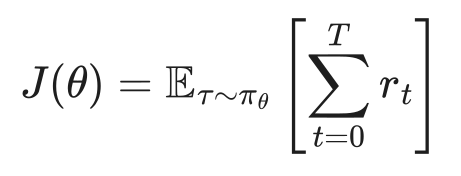
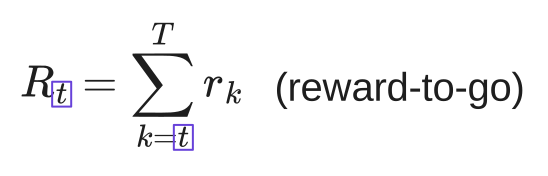
Policy Gradient Loss (reminder)


Episodic Policy Gradient
(in practice)



Policy Gradient (full)


Some remarks
- Noisy gradient
- Scales with action/policy dim
- Not a true gradient for the discounted case
Nota, Chris, and Philip S. Thomas. "Is the policy gradient a gradient?" 2019.
Tosatto, Samuele, et al. "A temporal-difference approach to policy gradient estimation." ICML, 2022.
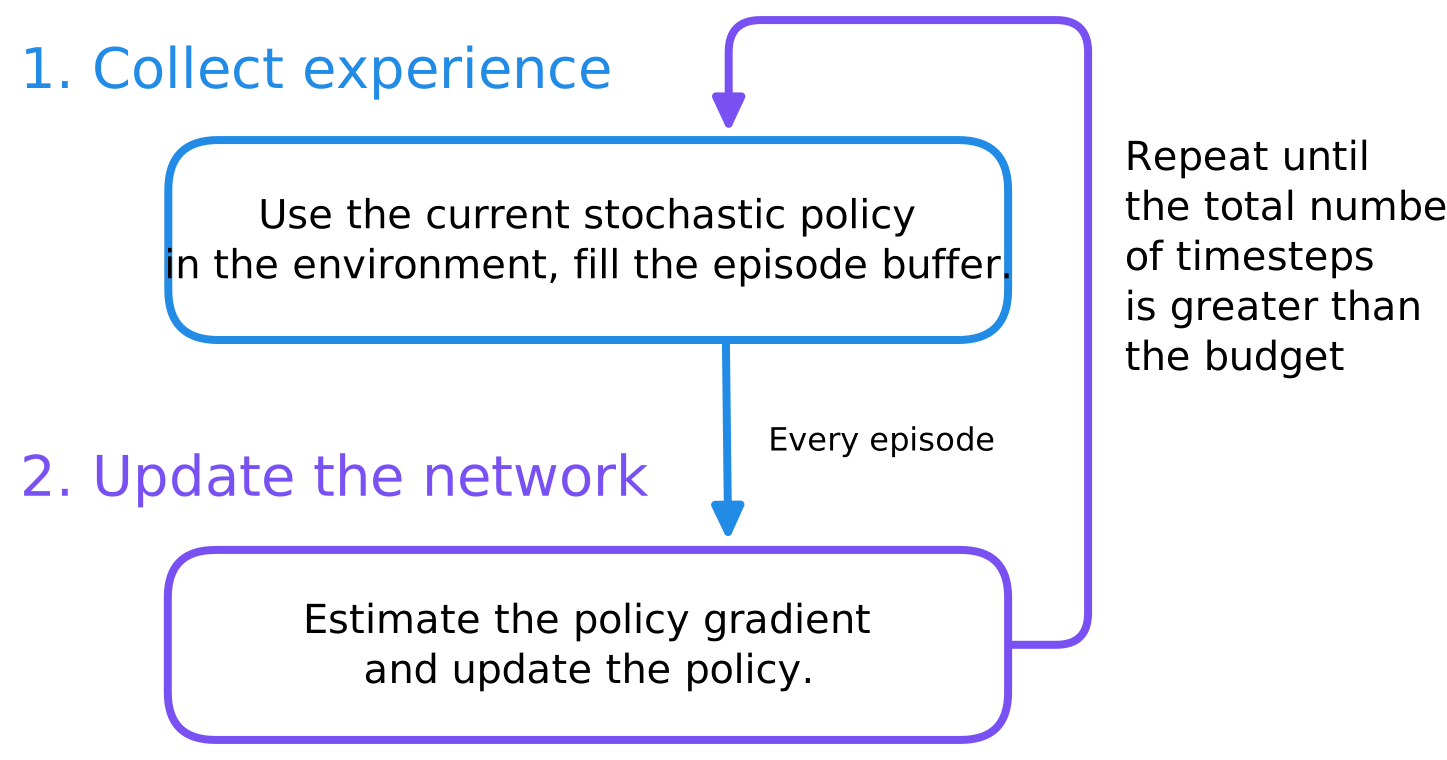
PG Training Loop
Exploration in Action Space
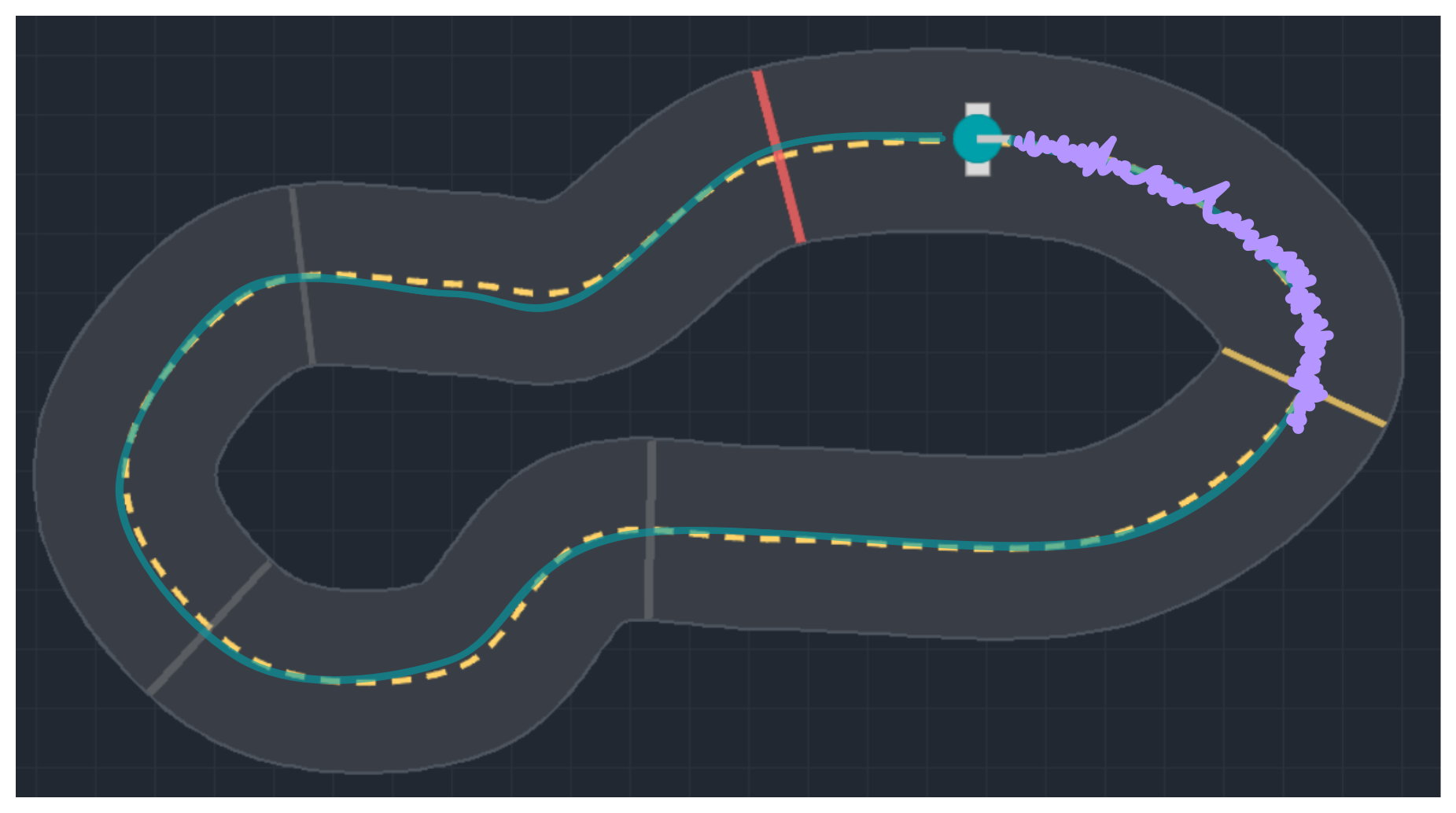
$a_t \sim \pi_\theta(a_t \mid s_t)$ stochastic policy
Action Distributions: Categorical
$$\pi_\theta(a_i \mid s_t) = \frac{\exp(z_{a_i})}{\sum_{j} \exp(z_{a_{j}})} $$ $$\text{where} \quad z = \theta^\top s_t \ \ \text{(logits)}, \quad \theta \in \mathbb{R}^{d \times A}$$
Action Distributions: Gaussian

$\mu_\theta(s_t) = \theta^\top s_t, \ \sigma \ \text{(learnable param)}$
$$\pi_\theta(a_t \mid s_t) = \mathcal{N}(\mu_\theta(s_t), \sigma^2 I)$$
Questions?
Policy Gradient (2nd notebook)
https://github.com/araffin/rlss26-pg-tutorialBackup Slides
How to train a value function
$$\mathcal{L}_{VF} = \frac{1}{T} \sum_{t=0}^{T-1} \big(V_\phi(s_t) - G_t\big)^2$$ Discounted returns: $G_t = \sum_{k=t}^{T} \gamma^{k-t} r_k$
Used as a baseline: $A_t = G_t - V_\phi(s_t)$ (unbiased, reduces variance)
                                class ValueNetwork(nn.Module):
                                    def __init__(self, obs_dim: int = 2):
                                        super().__init__()
                                        self.net = nn.Linear(obs_dim, 1)

                                    def predict_value(self, observation: th.Tensor) -> th.Tensor:
                                        return self.net(observation).squeeze(dim=-1)
Action distribution in PyTorch
Diagonally factored Gaussian (one independent $\mathcal{N}$ per action dim): $$\pi_\theta(\mathbf{a} \mid \mathbf{s}) = \prod_{i=1}^{A} \mathcal{N}(a_i; \, \mu_i(\mathbf{s}), \, \sigma_i^2)$$
                                class ContinuousLinearPolicy(nn.Module):
                                    def __init__(self, obs_dim: int = 2, action_dim: int = 2, std_init: float = 1.0):
                                        super().__init__()
                                        self.net = nn.Linear(obs_dim, action_dim, bias=True)
                                        self.log_std = nn.Parameter(th.ones(action_dim) * np.log(std_init))  # std > 0

                                    def get_action(self, observation: th.Tensor, deterministic = False) -> th.Tensor:
                                        action_mean = self.net(observation)
                                        # Diagonal covariance matrix
                                        action_std = th.ones_like(action_mean) * self.log_std.exp()
                                        action_dist = Normal(action_mean, action_std)
                                        if deterministic:
                                            return action_dist.mode
                                        return action_dist.sample()
Log probability of a Gaussian
Decomposes across the independent action dims: $$\log \pi_\theta(\mathbf{a} \mid \mathbf{s}) = \sum_{i=1}^{A} \left[ -\log \sigma_i - \frac{(a_i - \mu_i)^2}{2 \sigma_i^2} - \frac{1}{2} \log(2\pi) \right]$$
$\mathcal{L}_{PG} = -\frac{1}{T} \sum_{t} \log \pi_\theta(a_t \mid s_t) \cdot A_t$
                                def get_log_prob(self, observations: th.Tensor, actions: th.Tensor) -> th.Tensor:
                                    action_mean = self.net(observations)
                                    action_std = th.ones_like(action_mean) * self.log_std.exp()
                                    # Create Gaussian distribution object
                                    action_dist = Normal(action_mean, action_std)

                                    return action_dist.log_prob(actions).sum(dim=-1)  # independent dimensions