Making RL Work
Out-of-the-Box
(WIP)
Outline
- RL is hard
- $N$ implementation details of $Y$ (where $N >> 1$)
- Reducing algorithm and environment complexity
- Case study: SAC in IsaacSim (env design + HPO)
- Newton RL Pipeline
RL is Hard (Episode #5623)
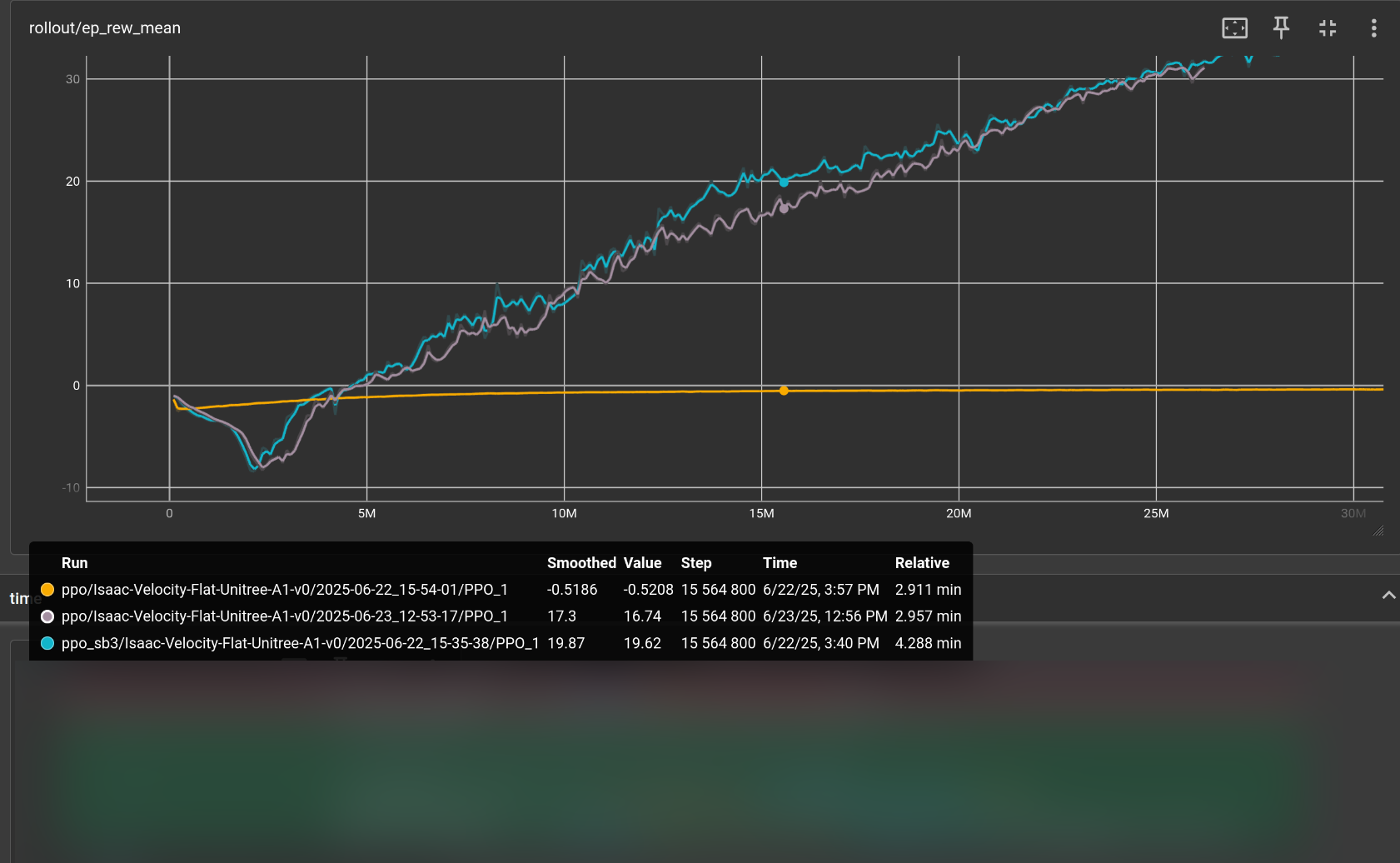
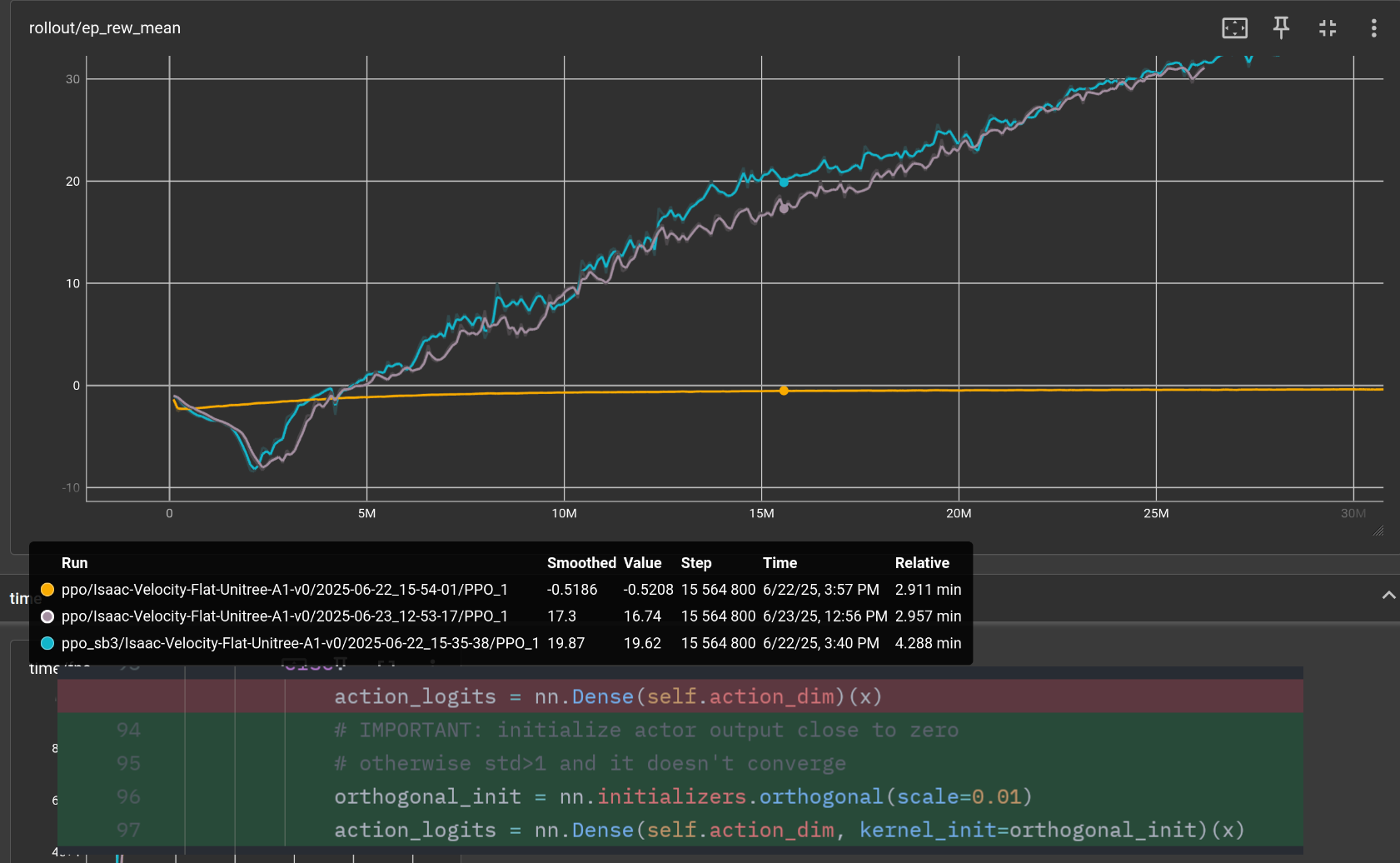
There is only one line of code that is different.
RL is Hard (Episode #4352)
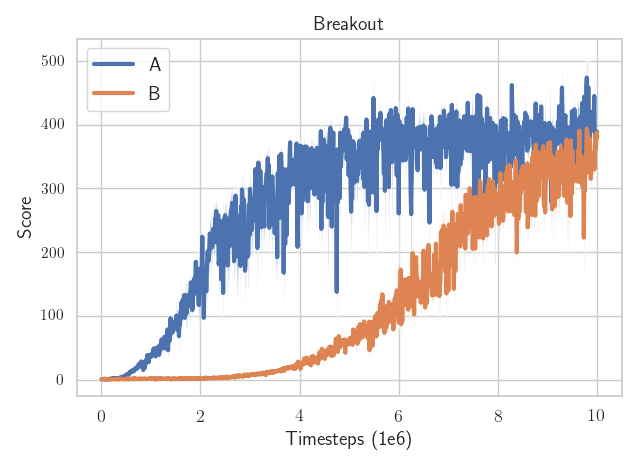
Which algorithm is better?
The only difference: the epsilon value to avoid division by zero in the optimizer
(one is eps=1e-7
the other eps=1e-5)
Stable-Baselines3 (SB3)
                                    import gymnasium as gym
                                    from stable_baselines3 import SAC

                                    # Train an agent using Soft Actor-Critic on Pendulum-v1
                                    env = gym.make("Pendulum-v1")
                                    model = SAC("MlpPolicy", env).learn(total_timesteps=20_000)
                                    # Save the model
                                    model.save("sac_pendulum")
                                    # Load the trained model
                                    model = SAC.load("sac_pendulum")
                                    # Start a new episode
                                    obs, _ = env.reset()
                                    # What action to take in state `obs`?
                                    action, _ = model.predict(obs, deterministic=True)
https://github.com/DLR-RM/stable-baselines3
Raffin, Antonin, et al. "Stable-baselines3: Reliable reinforcement learning implementations." JMLR (2021)
Reliable Implementations?

- Performance checked
- Software best practices (96% code coverage, type checked, ...)
- Active community (13k+ stars, 5000+ citations, 20M+ downloads)
- Fully documented
Reproducible Reliable RL: SB3 + RL Zoo
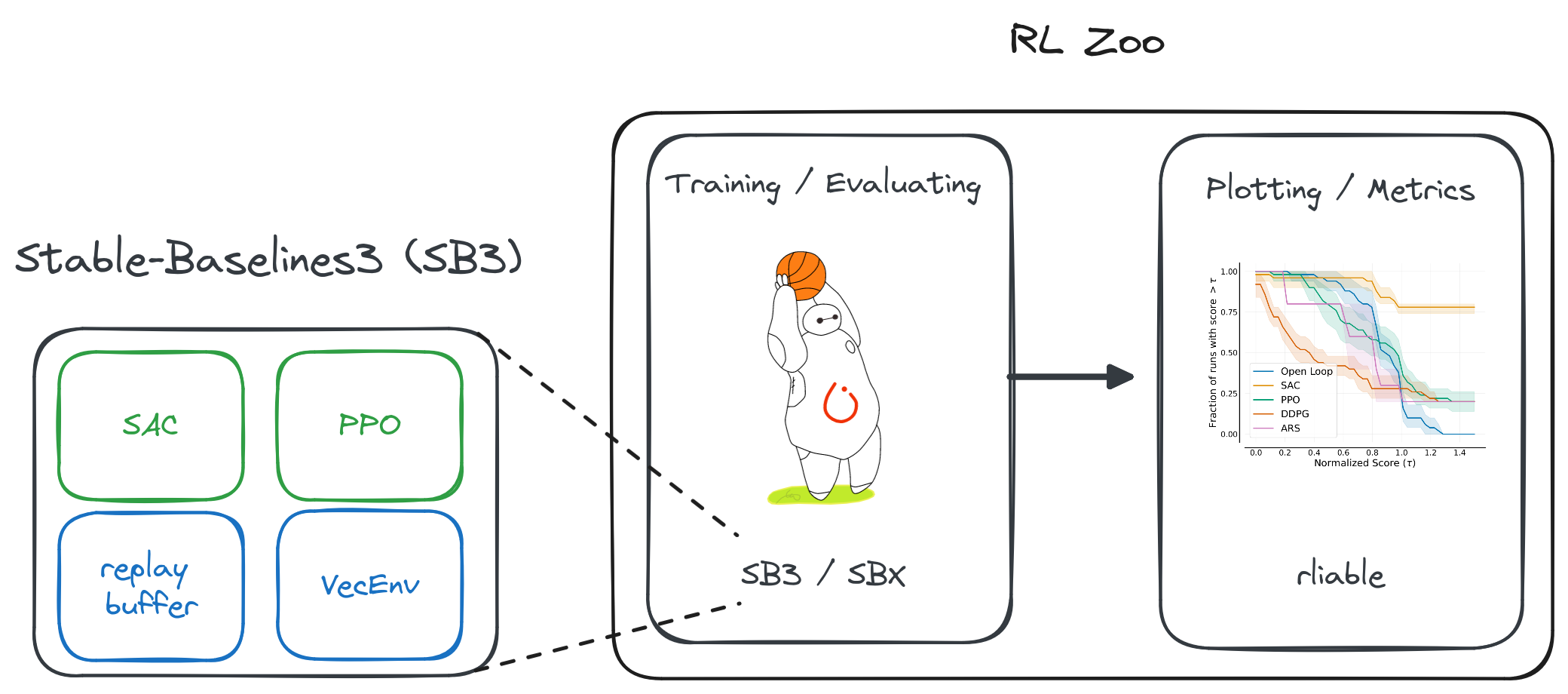
RL from scratch in 10 minutes
Using SB3 + Jax = SBX: https://github.com/araffin/sbx
- RL is hard
- $N$ implementation details of $Y$ (where $N >> 1$)
- Reducing algorithm and environment complexity
- Case study: SAC in IsaacSim (env design + HPO)
- Newton RL Pipeline
The 37 Implementation Details of PPO
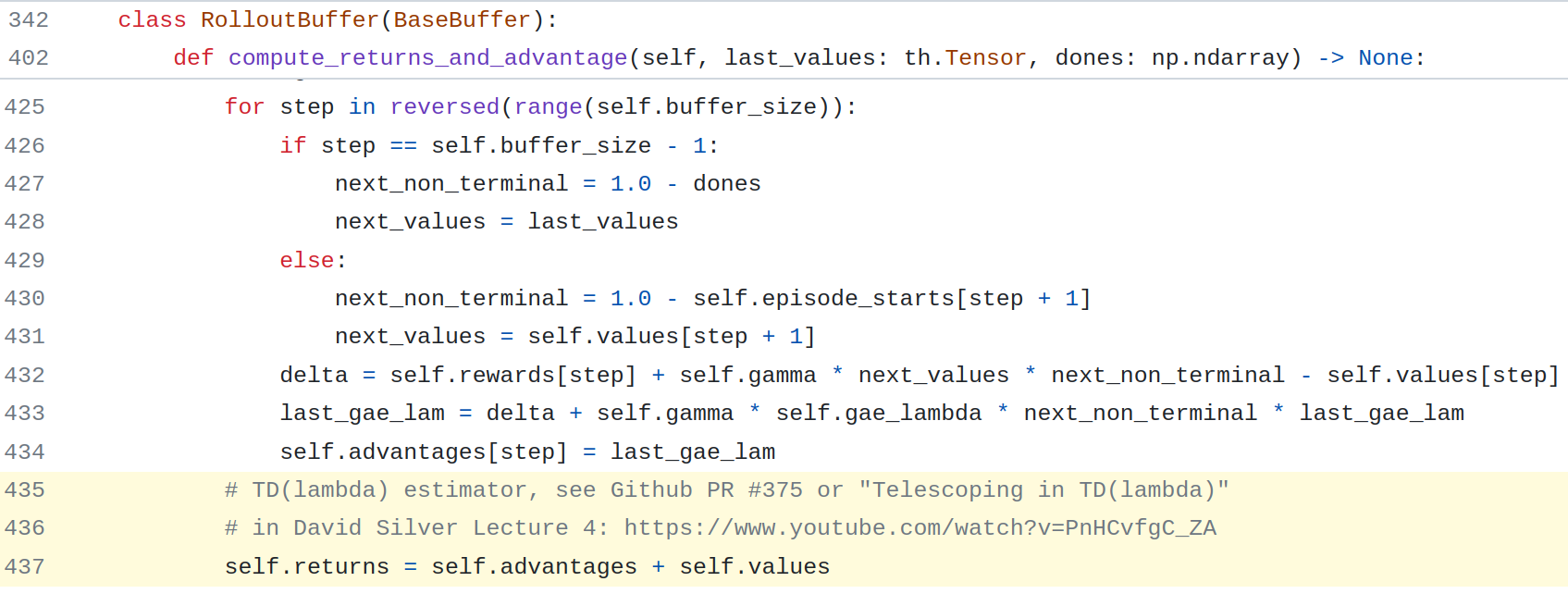
https://iclr-blog-track.github.io/2022/03/25/ppo-implementation-details/
DQN: Hidden Details in the Appendix


Open RL Benchmark
- Large scale, multi library (SB3, CleanRL, torchRL, ...)
- Comprehensive tracked metrics, saved hyperparameters
- Reproducible experiments
- Easy access and visualization (cli)
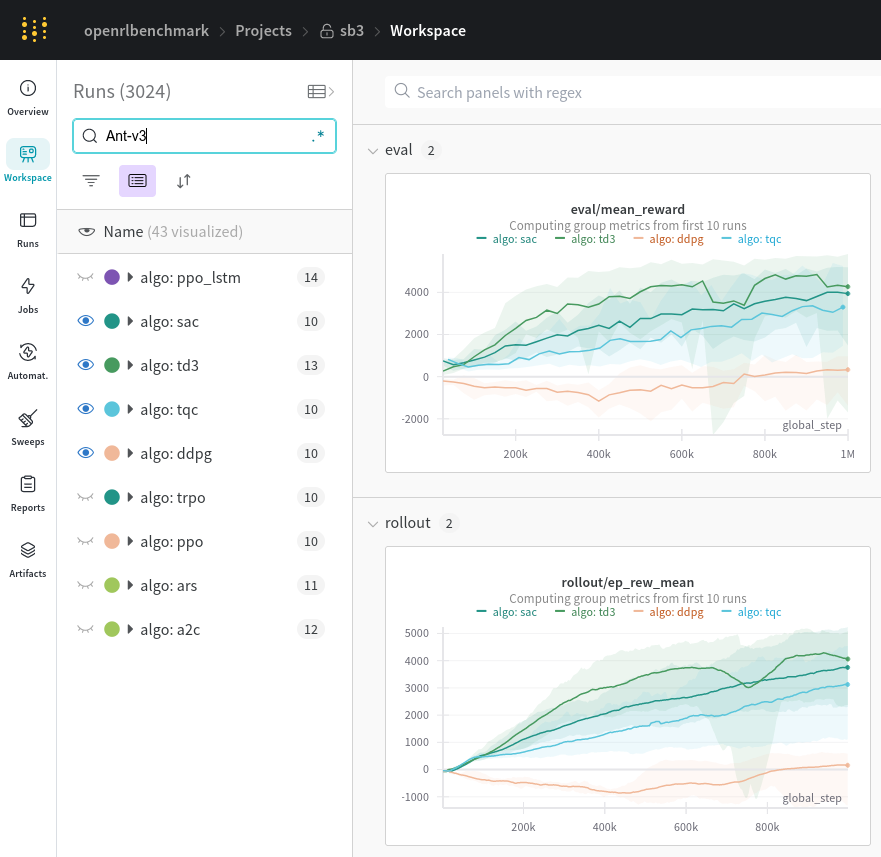
Huang, Shengyi, et al. "Open RL Benchmark: Comprehensive Tracked Experiments for RL." (2024).
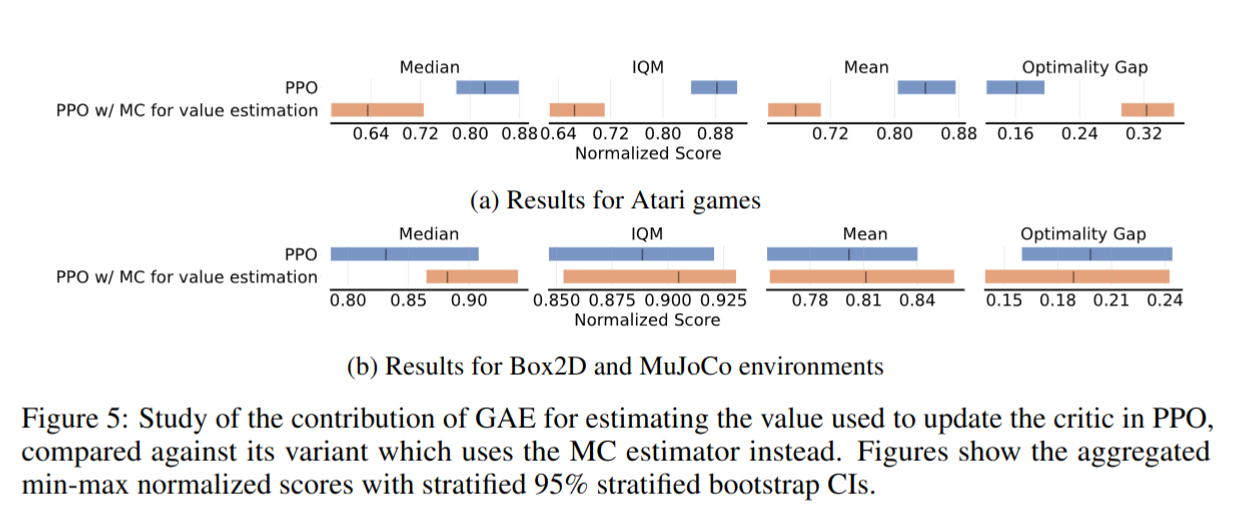
Open RL Benchmark Study
- RL is hard
- $N$ implementation details of $Y$ (where $N >> 1$)
- Reducing algorithm and environment complexity
- Case study: SAC in IsaacSim (env design + HPO)
- Newton RL Pipeline
An Open-Loop Baseline for RL Locomotion Tasks
Periodic Policy
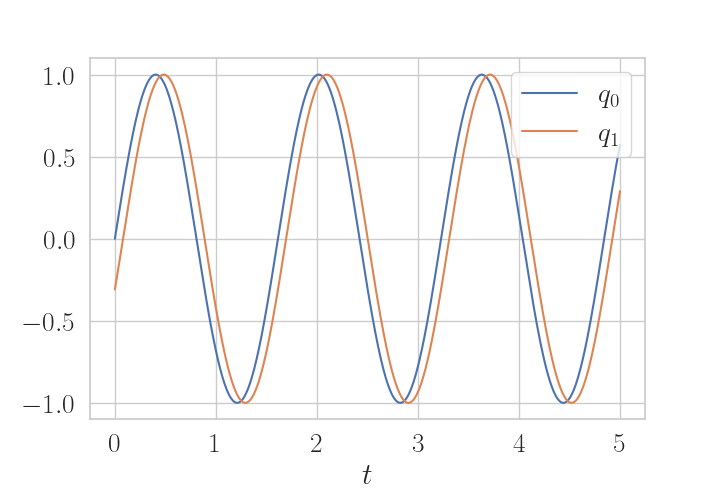
Raffin et al. "An Open-Loop Baseline for Reinforcement Learning Locomotion Tasks", RLJ 2024.
Outstanding Paper Award on Empirical Resourcefulness in RL
Cost of generality vs prior knowledge
Learning from human feedback
Raffin, Antonin "Enabling Reinforcement Learning on Real Robots." Diss. TUM, 2024.
Adapting quickly: Retrained from Space
- RL is hard
- $N$ implementation details of $Y$ (where $N >> 1$)
- Reducing algorithm and environment complexity
- Case study: SAC in IsaacSim (env design + HPO)
- Newton RL Pipeline
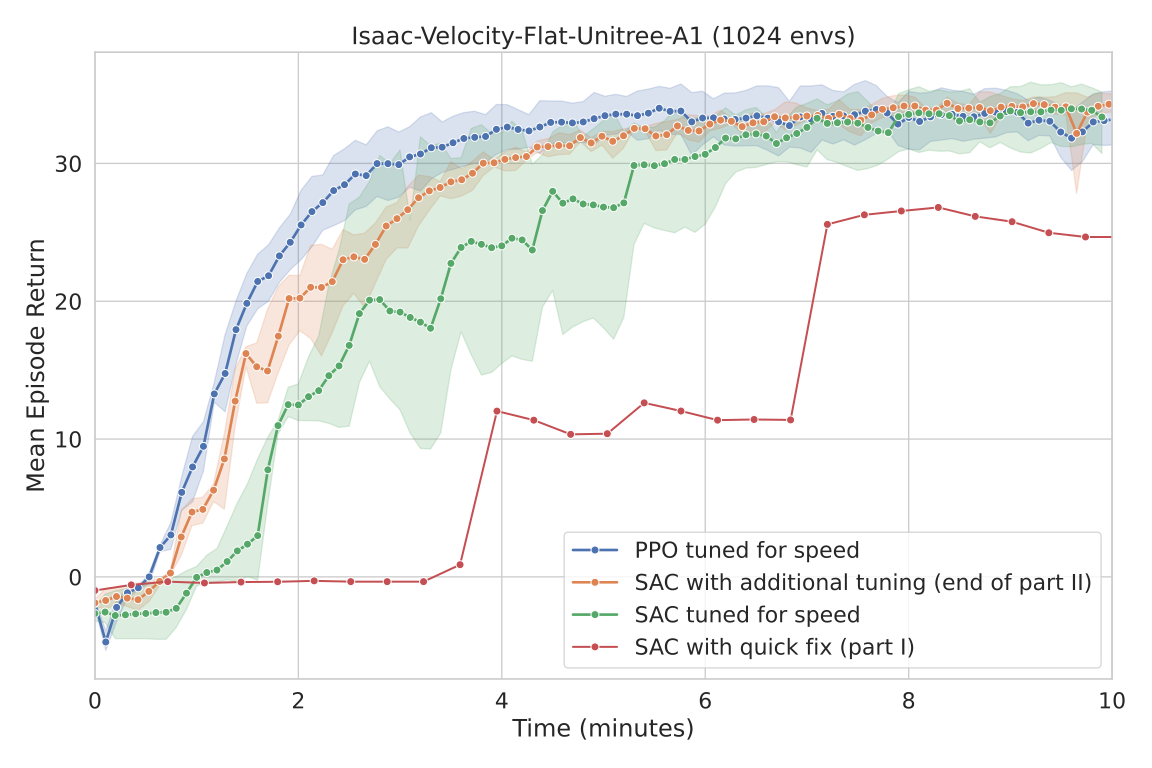
Making SAC work on Massive Parallel Sim
Out of the box
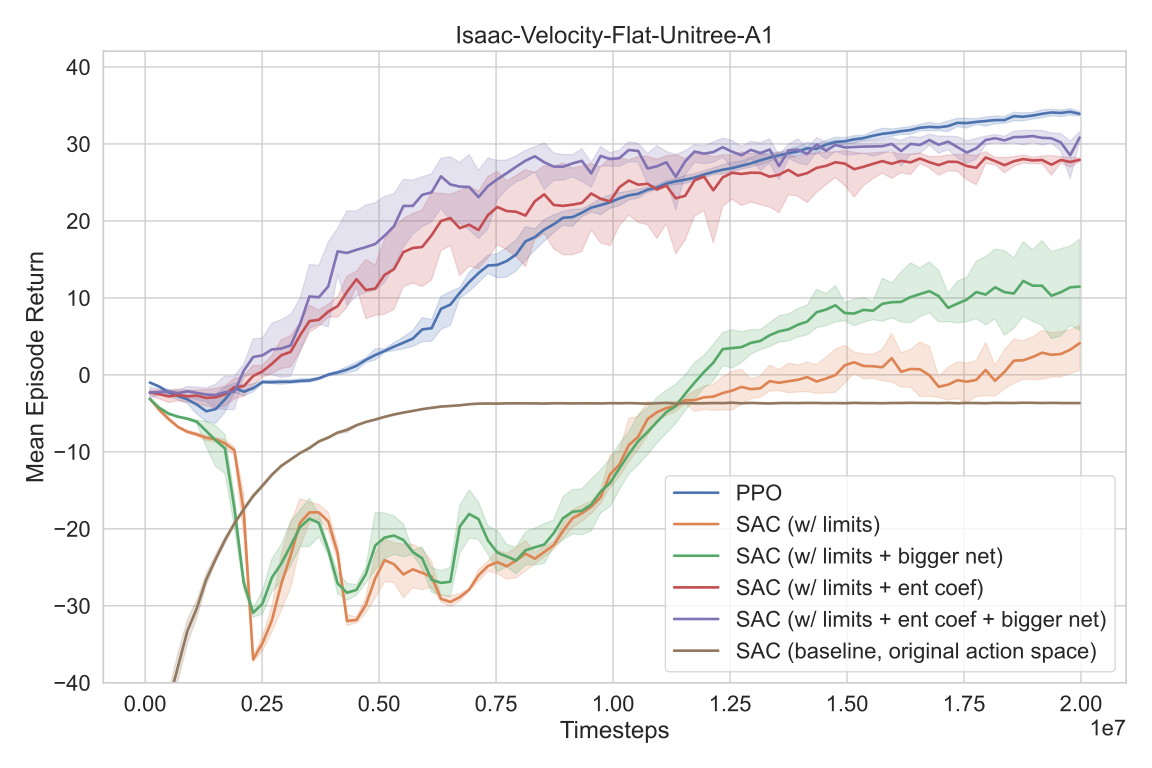
Action Space and Action Dist
                            # Note: desired_joint_pos is of dimension 12 (3 joints per leg)
                            desired_joint_pos = default_joint_pos + scale * action

                            # Debugging action space
                            import ipdb; ipdb.set_trace()
                            >> vec_env.action_space
                            Box(-100.0, 100.0, (12,), float32)
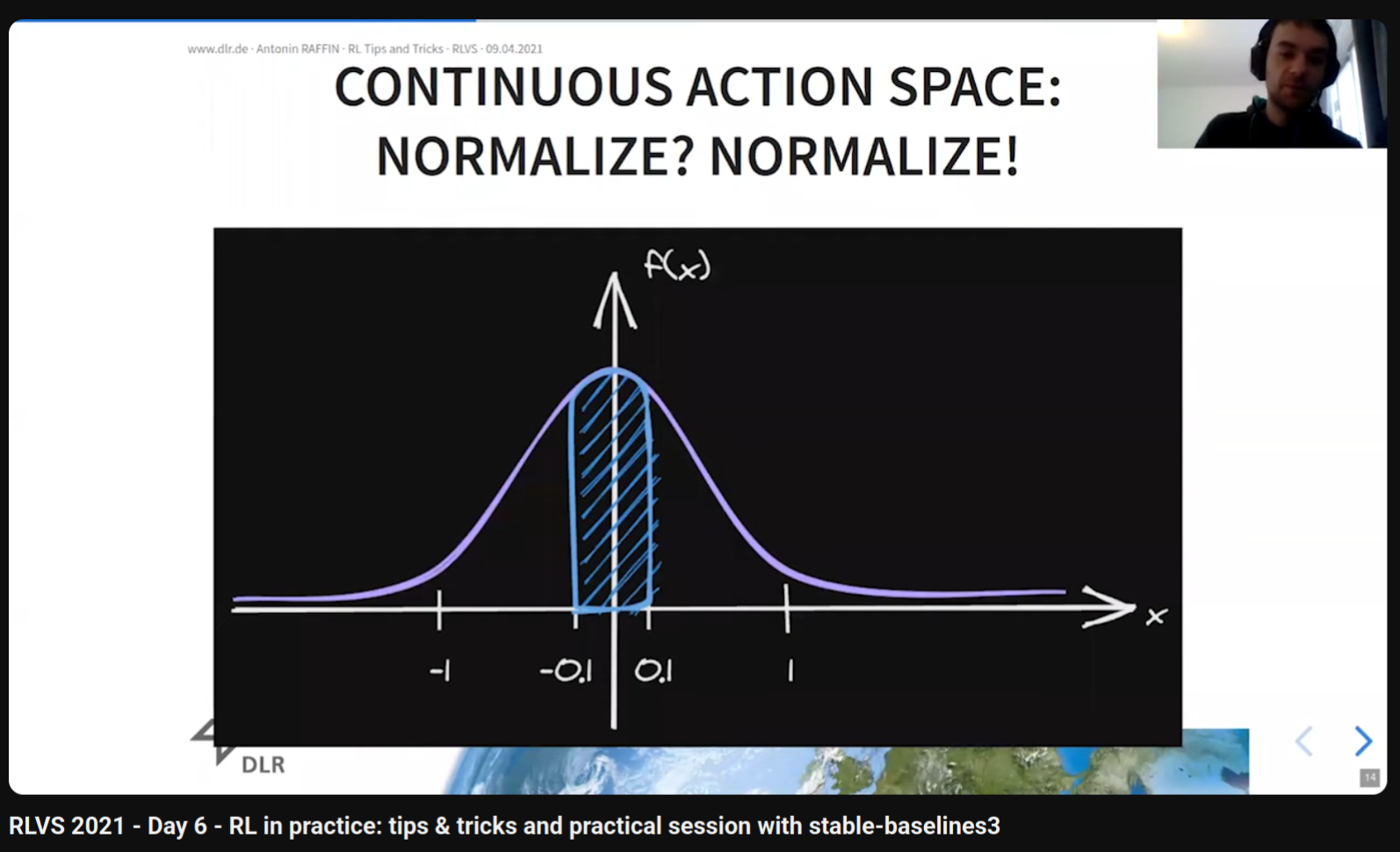
PPO Gaussian Distribution


SAC Gaussian Distribution


Ablation Study
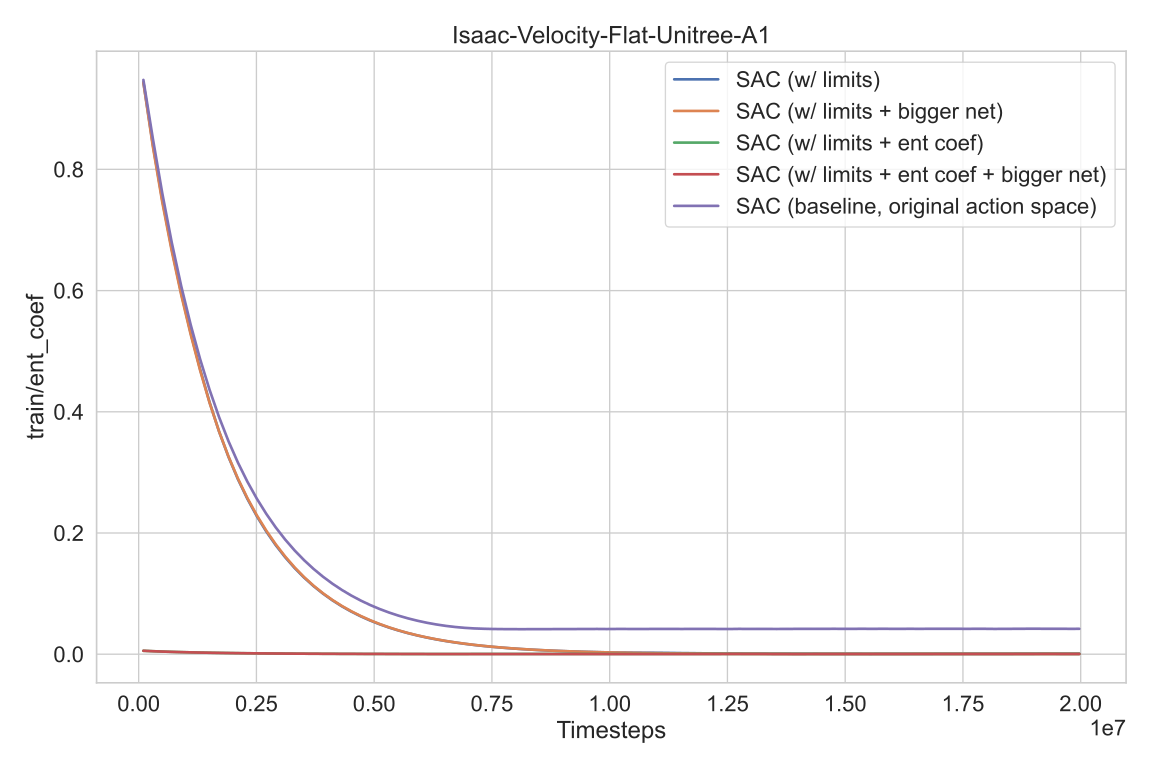
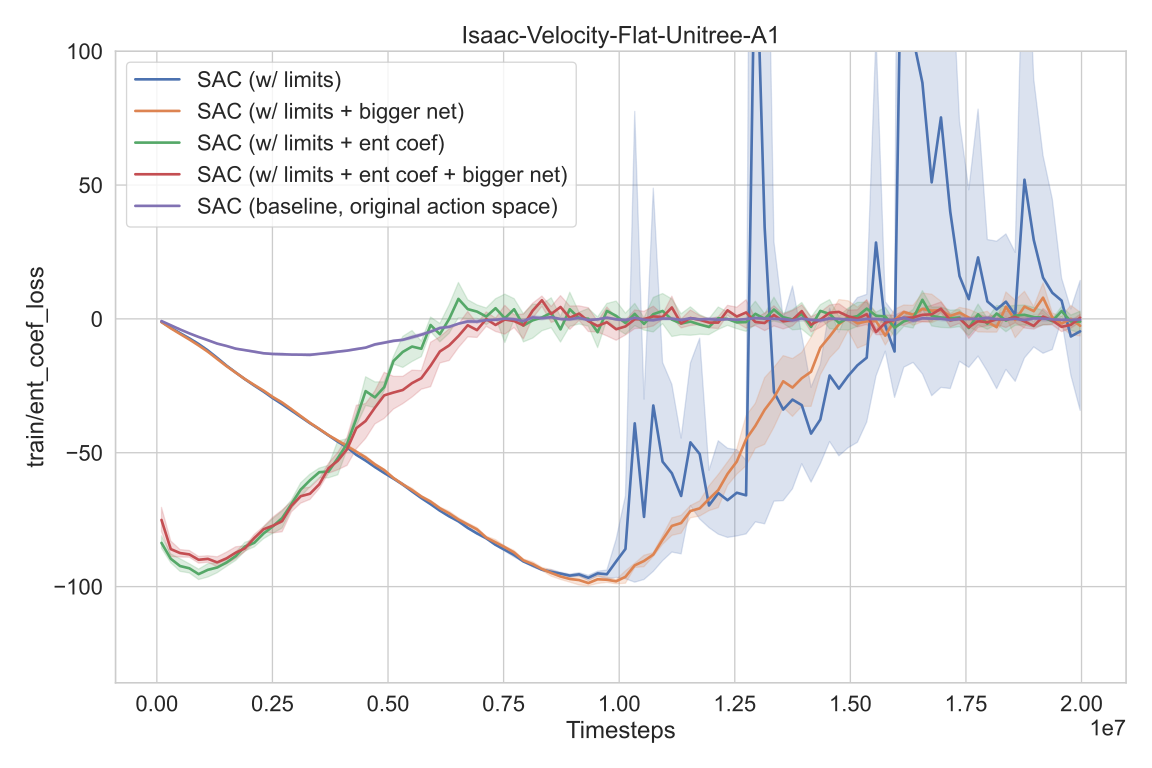
SAC Entropy Coefficient
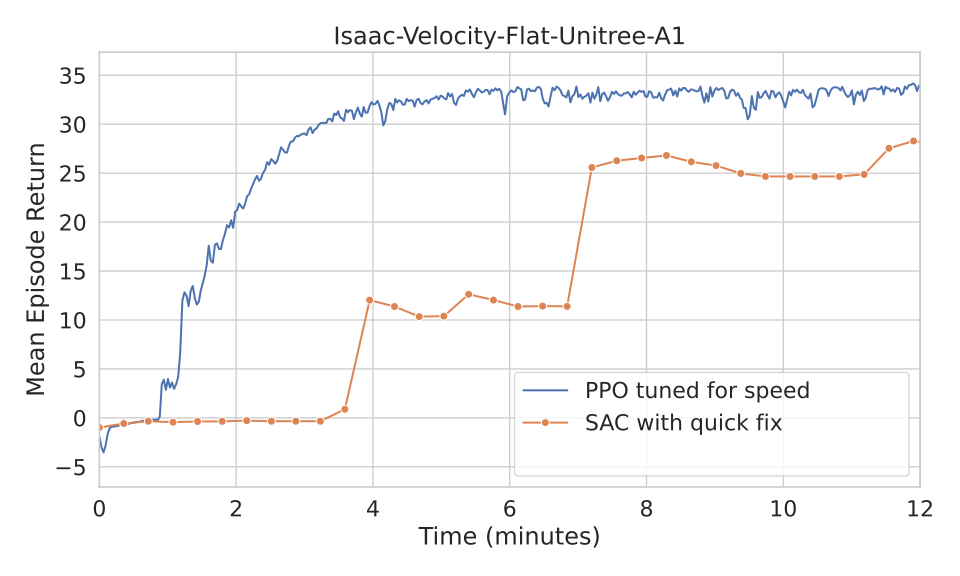
Optimizing for speed
                            def objective(trial: optuna.Trial) -> float:
                                """Optimize for best performance after 5 minutes of training."""
                                # Sample hyperparameters
                                hyperparams = sample_sac_params(trial)
                                agent = sbx.SAC(env=env, **hyperparams)
                                # Callback to exit the training loop after 5 minutes
                                callback = TimeoutCallback(timeout=60 * 5)
                                # Train with a max budget of 50_000_000 timesteps
                                agent.learn(total_timesteps=int(5e7), callback=callback)
                                # Log the number of interactions with the environments
                                trial.set_user_attr("num_timesteps", agent.num_timesteps)
                                # Evaluate the trained agent
                                env.seed(args_cli.seed)
                                mean_reward, std_reward = evaluate_policy(agent, env, n_eval_episodes=512)
                                return mean_reward
- RL is hard
- $N$ implementation details of $Y$ (where $N >> 1$)
- Reducing algorithm and environment complexity
- Case study: SAC in IsaacSim (env design + HPO)
- Newton RL Pipeline
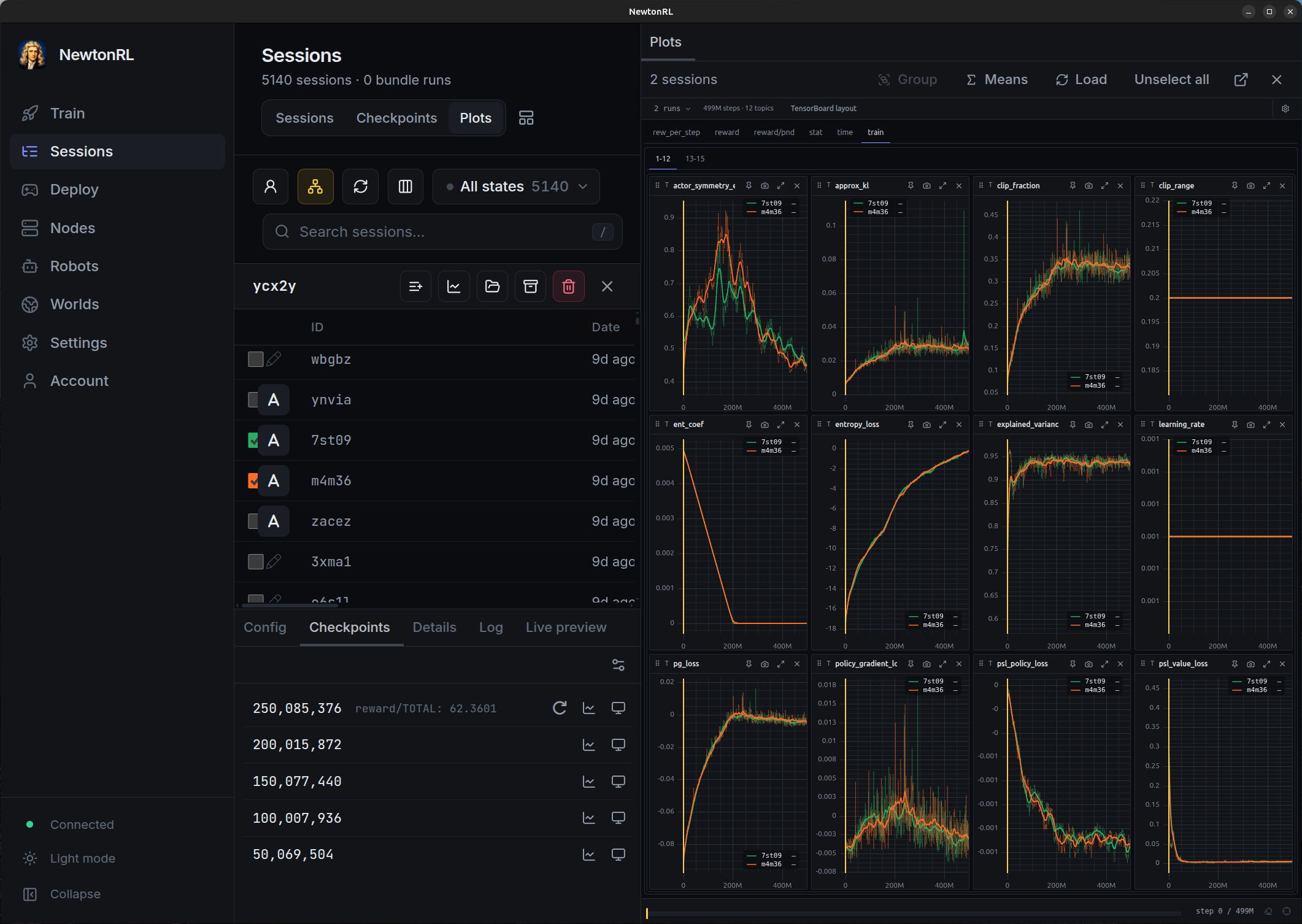
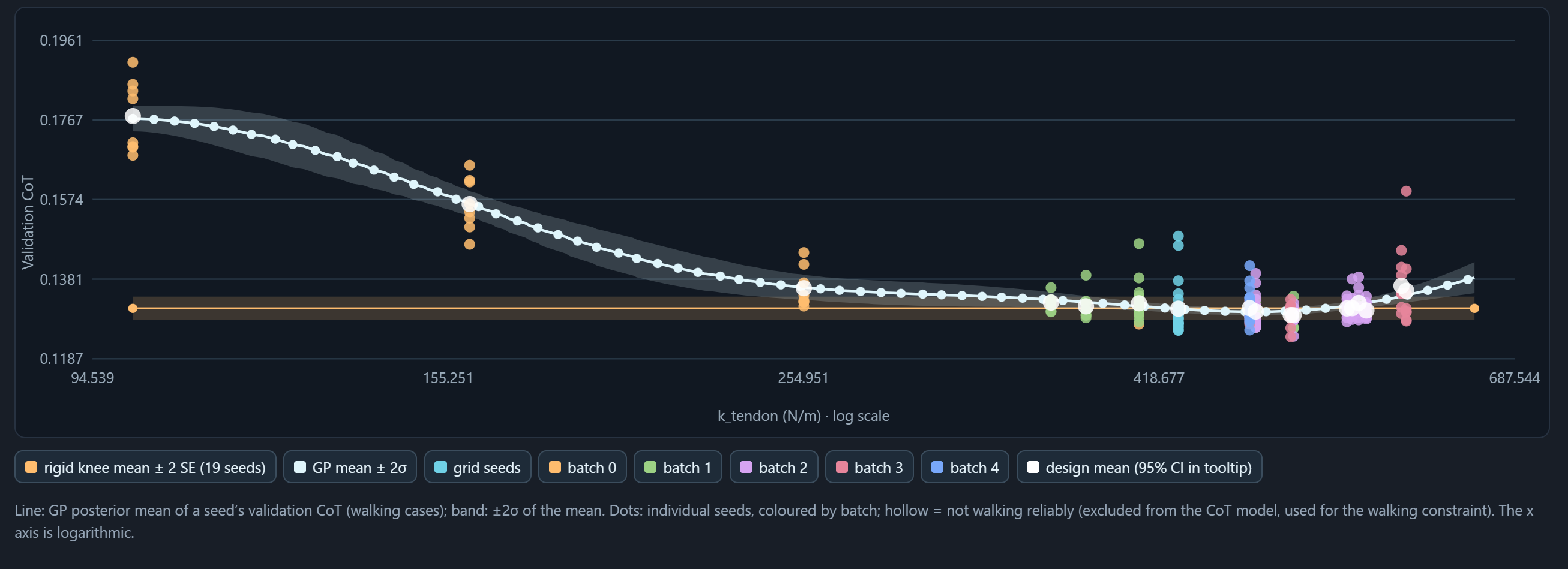
Newton RL Pipeline
A GUI to train and visualize RL policies with SB3 in the Newton simulator
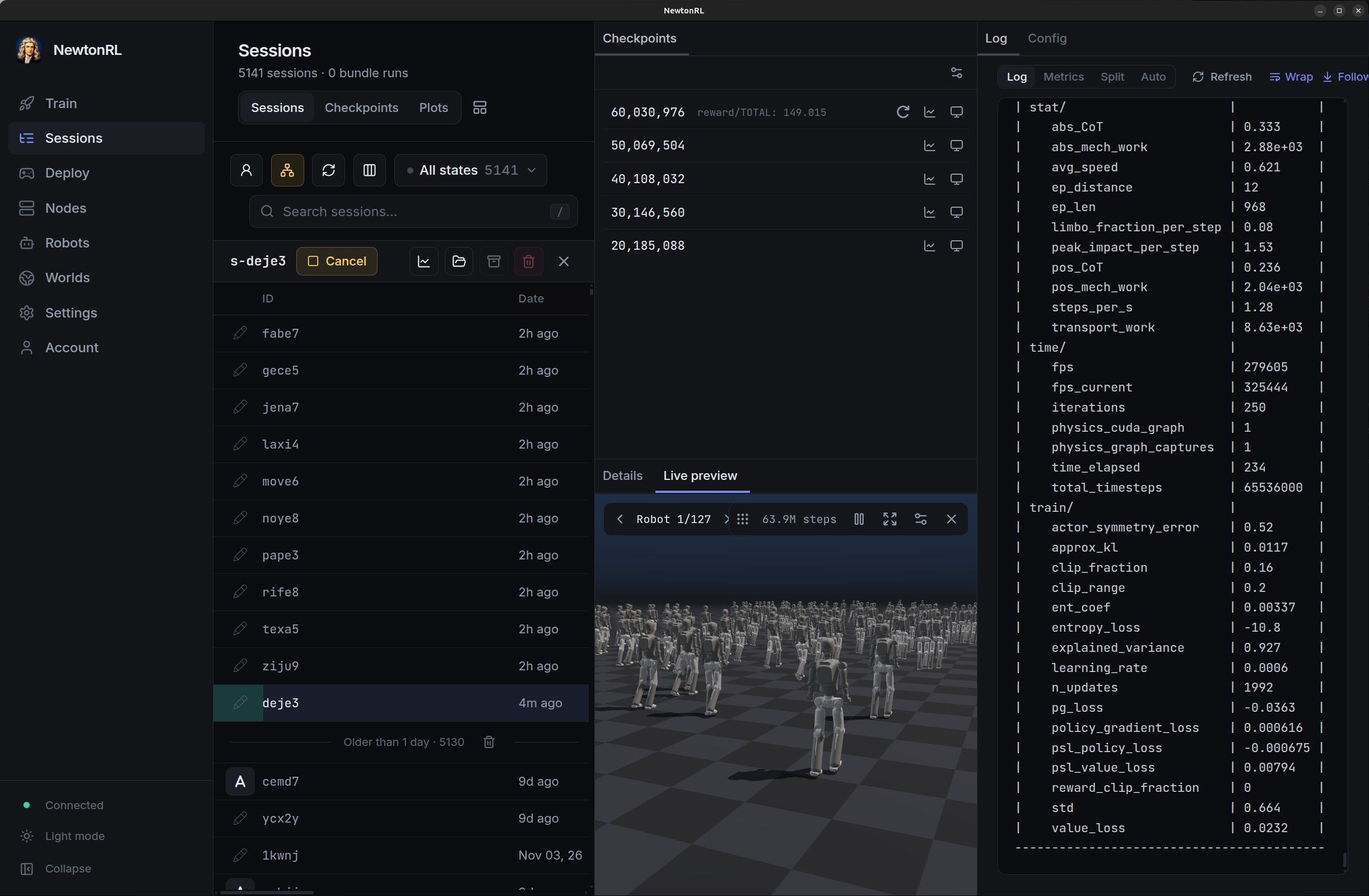
Train & Monitor
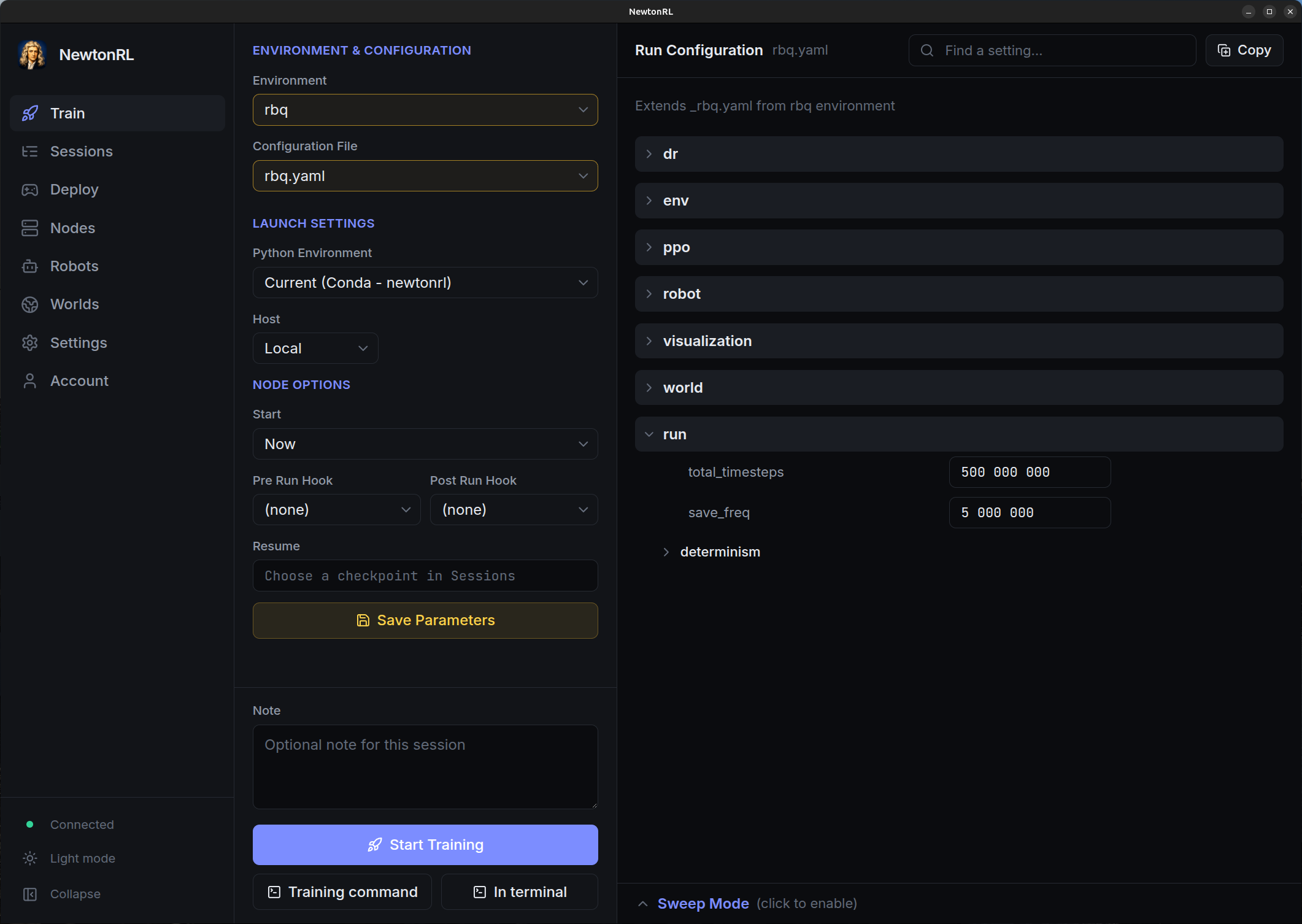
Enabling Co-design
Mechanical engineers can train and visualize policies without RL expertise
Conclusion
- Software engineering for reliable implementations
- Experiments database (OpenRL Benchmark)
- Reducing complexity
- Env design (reward, action space)
- Automatic hyperparameter tuning
- Newton RL Pipeline
Questions?
Backup Slides
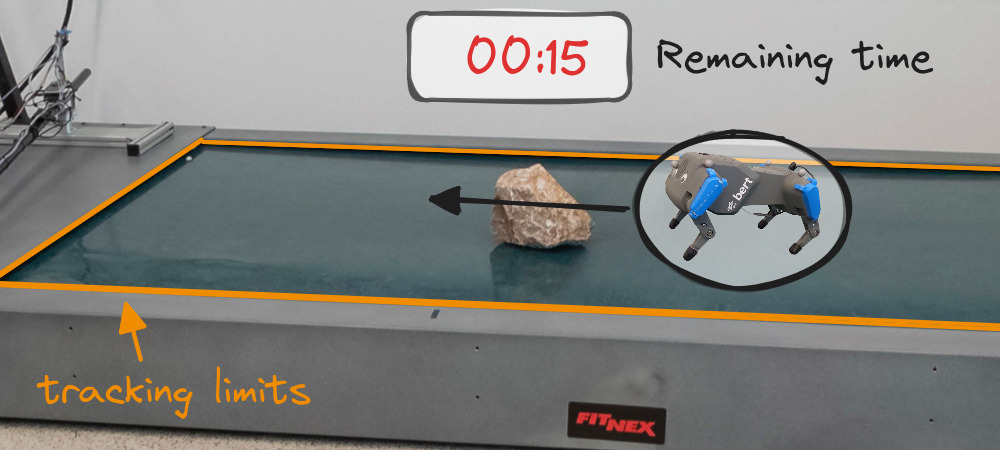
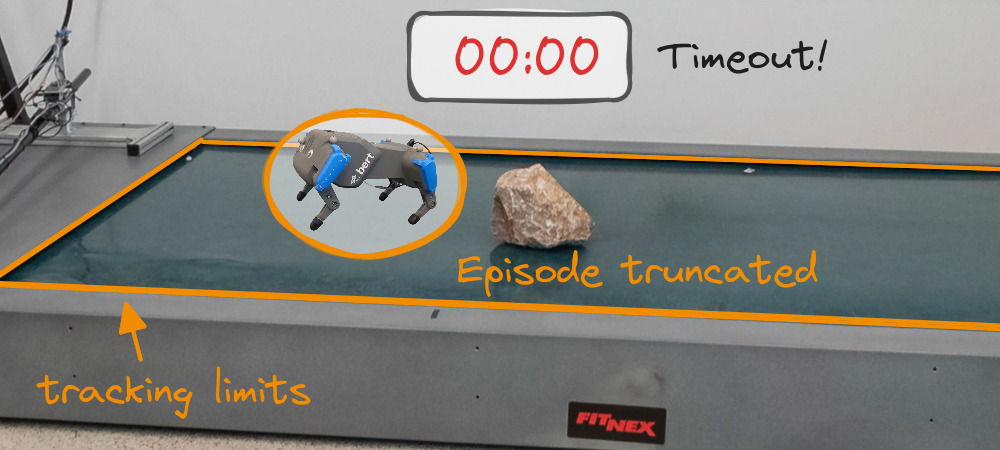
Truncations for infinite horizon tasks
truncation vs termination


Example
Timeout: max_episode_steps=4
-
Without truncation handling:
$V_\pi(s_0) = \mathop{\sum^{\textcolor{a61e4d}{3}}_{t=0}}[\gamma^t r_t] = 1 + 1 \cdot 0.98 + 0.98^2 + 0.98^3 \approx 3.9 $ -
With truncation handling:
$V_\pi(s_0) = \mathop{\sum^{\textcolor{green}{\infty}}_{t=0}}[\gamma^t r_t] = \sum^{\textcolor{green}{\infty}}_{t=0}[\gamma^t] = \frac{1}{1 - \gamma} \approx 50 $
Recall: DQN Update
- DQN loss:
\[\begin{aligned} \mathcal{L} = \mathop{\mathbb{E}}[(\textcolor{#a61e4d}{y_t} - \textcolor{#1864ab}{Q_\theta(s_t, a_t)} )^2] \end{aligned} \]
- Regression $ \textcolor{#1864ab}{f_\theta(x)} = \textcolor{#a61e4d}{y}$
with input $\textcolor{#1864ab}{x}$ and target $\textcolor{#a61e4d}{y}$:
- input: $\textcolor{#1864ab}{x = (s_t, a_t)}$
- if $s_{t+1}$ is non terminal: $y = r_t + \gamma \cdot \max_{a' \in A}(Q_\theta(s_{t+1}, a'))$
- if $s_{t+1}$ is terminal: $\textcolor{a61e4d}{y = r_t}$
- if $s_{t+1}$ is truncation: $y = r_t + \gamma \cdot \max_{a' \in A}(Q_\theta(s_{t+1}, a'))$
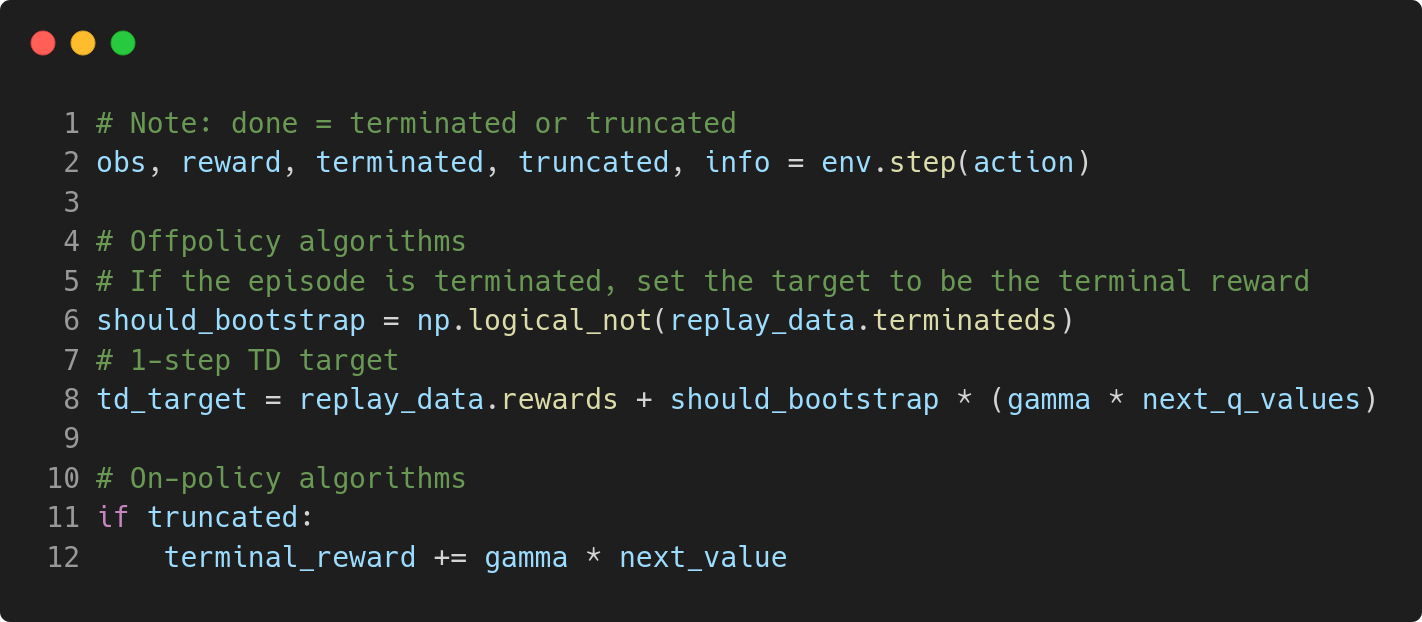
In Practice